
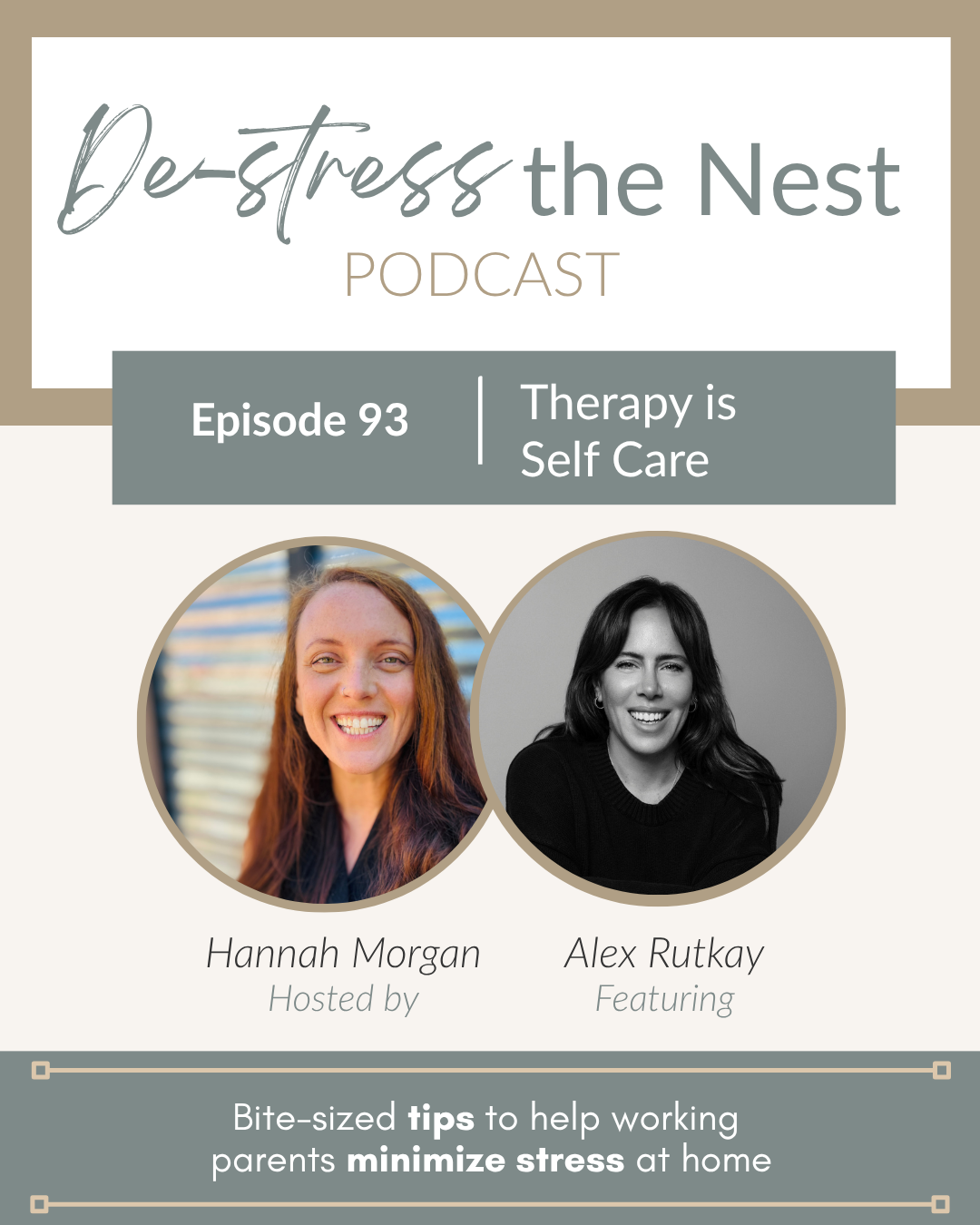
Episode 93 – Therapy is Self Care with Alex Rutkay
What if one of the best ways to take care of your family was taking care of yourself first?
Therapy is often misunderstood as something reserved for moments of crisis, but in reality, it can be one of the healthiest forms of self-care. In this episode of De-Stress the Nest, Hannah Morgan sits down with entrepreneur, content creator, and City Mouse founder Alex Rutkay to discuss why therapy deserves a place in every working parent's toolkit.
Together they explore how mental health support has evolved, why finding the right therapist matters, how therapy looks different in different seasons of life, and where AI may—and may not—fit into the future of mental wellness.
Whether you're navigating anxiety, grief, burnout, or simply trying to become a healthier version of yourself, this conversation is a reminder that asking for help isn't weakness—it's wisdom.
Key Takeaways
Therapy is one of the most powerful forms of self-care—not just a tool for times of crisis.
Seeking support during difficult seasons is a sign of strength, not weakness.
Finding the right therapist can make all the difference in your mental health journey.
Processing life's challenges is healthier than simply pushing through them.
Conversations around mental health are becoming more open, helping to break long-standing stigma.
AI can complement mental wellness practices, but it can't replace meaningful human connection.
Investing in your own well-being allows you to show up more fully for your family and the people you love.
Quotes
"The person I was when I started therapy versus the person I am now are two very different people."
"Therapy is a beautiful thing—to know thyself."
"If you're saying the same thing week after week, pay attention to it… and then grow from it."
"When you need a new set of tools to get through a difficult season, therapy can provide that."
"There's a real benefit to talking to another human being and getting to know yourself better that way."
Resources Mentioned
City Mouse - A thoughtfully designed diaper bag brand founded by Alex Rutkay.
Heron House Management - Virtual house management for busy families: we handle your to-dos so you can focus on what matters most. Learn more at www.heronhousemanagement.com.
If you enjoyed this episode, please subscribe and leave a review on Spotify, iHeartRadio, Apple Podcasts or your favorite podcast platform. Your feedback helps us reach more listeners and continue to bring you valuable content!
Episodes Released Weekly on Tuesdays
This episode of De-Stress the Nest is sponsored by Heron House Management. Learn more at www.heronhousemanagement.com.
About Heron House Management:
Heron House Management is a virtual house management service that takes the stress out of your busy life by taking on your mental load and managing your To Do list. We provide fractional virtual house management for busy families at 10, 15 and 20+ hours/month.
Meal planning, signing up for kids activities, scheduling doctor's appointments, finding a house cleaner, planning your kid's birthday party, getting quotes for that home renovation project, or scheduling a monthly date night with your significant other and so much more. We do it all! Learn more at www.heronhousemanagement.com.
About Hawkeye Focus Coaching:
Hawkeye Focus Coaching helps ADHD executives, entrepreneurs, and busy professionals turn ideas into action. Through personalized, hands-on coaching, deep work sessions, accountability, and practical systems, we help clients overcome overwhelm, stay focused on what matters most, and make consistent progress toward their goals.
Whether you're launching a business, leading a team, managing a major project, or trying to get out of constant firefighting mode, Hawkeye Focus Coaching helps you work with greater clarity, confidence, and momentum. Learn more at www.hawkeyefocuscoaching.com.
-
[00:00] Hannah Morgan:
Welcome to De-Stress the Nest, a podcast for busy parents where experts share bite-sized tips on how to create systems that minimize stress at home. I'm your host, Hannah Morgan.
[00:12] Hannah Morgan:
Today's episode is sponsored by Heron House Management, the first-ever virtual house management service that lightens your mental load by handling your to-do list with monthly subscriptions of 10, 15, and 20+ hours per month. From meal planning and doctor's appointments to birthday parties and home projects, Heron House Management helps busy families reclaim their time and live their best lives. Learn more at heronhousemanagement.com.
[00:37] Hannah Morgan:
Alex, I'm so excited to have you on the show today. We actually connected through TikTok, which is such a fun way to build community and connect with others. I'm thrilled to be able to introduce you to our audience here with De-Stress the Nest. So why don't you share a little bit about who you are and what you do?
[00:55] Alex Rutkay:
Thank you so much for having me. My name is Alex Rutkay. I am a mom, I'm an entrepreneur, I own the brand City Mouse, which is a product-based business that I run out of my New York City living room, and I also work as a celebrity makeup artist for my day job in entertainment.
[01:15] Hannah Morgan:
I love it. She's a busy lady!
[01:18] Hannah Morgan:
Alex, I'm so excited to have you on the show today, and you're going to talk to us about the importance of therapy. I think it's a very real topic that just isn't talked about enough. There's so much stigma around it, and it's 2026—we're finally recognizing mental health as a priority. So let's talk about how important therapy is and what we should be doing to incorporate it into our lives.
[01:48] Alex Rutkay:
I'm a big proponent of therapy—talk therapy specifically. I've also done other modalities like cognitive behavioral therapy. I'm somebody who has a lot of anxiety, so that's something I work through in therapy.
I've been in and out of therapy since 2013. I've had some great therapists and I've had some bad therapists, but one thing I can tell you is that the person I was when I started therapy versus the person I am now are two very different people.
It's really taught me to come into myself in a way that I wasn't comfortable with before. I think it's important to show up regularly, but it's also important to listen to the things you're saying. If you're saying the same thing week after week, pay attention to it and grow from it.
I'm one of those people who goes into therapy for a reason, works through that season, and then leaves. Then maybe I'll come back again later for something different.
There used to be a stigma around therapy, but now I almost feel like it's the opposite. If you're not talking about your mental health, that's what's unusual. I still know people who've never had a therapist, and I think they would greatly benefit from it. Therapy is a beautiful thing—to know thyself.
[03:16] Hannah Morgan:
It's new, especially as millennial moms. I think we've been pushed to our breaking point where it's therapy or bust—you've got to figure it out.
Even five or ten years ago, people weren't talking about therapy this openly. I remember sitting around the Thanksgiving table talking about what cause we'd champion if we were First Lady, and my sister said mental health. At the time, I thought that was so ahead of where the conversation was.
Our parents' generation often believed you should keep your feelings to yourself and just push through. We're trying to break those generational patterns now. Gen Z seems to have embraced wellness and mental health, while we're still coming out of decades of believing it was something private or shameful.
[04:13] Alex Rutkay:
I spend a lot of time on social media, so I definitely see younger generations talking about mental health more comfortably.
I also think it's important to find balance. Protecting your mental health matters, but we don't want to swing too far in the other direction either.
At the end of the day, therapy is so much more beneficial than it is detrimental or embarrassing. That's how I make decisions—I look at the cost versus the benefit, and the benefits absolutely outweigh any discomfort.
[04:55] Hannah Morgan:
Especially for you, you've gone through some incredibly significant life experiences: your own cancer diagnosis, losing your mom, becoming a parent during the pandemic, launching a successful retail brand, and balancing so many priorities.
If you don't have someone advocating for you, you're trying to carry all of that by yourself, and that's not somewhere any of us want to be.
[05:20] Alex Rutkay:
No. Nobody can handle all of that by themselves.
Like we've talked about before, sometimes giving up a little control or allowing someone else to help carry the load really makes all the difference.
[05:34] Hannah Morgan:
You mentioned that you return to therapy during seasons when you need extra support, but it's not necessarily something you do every week for the rest of your life. Tell me more about that.
[05:48] Alex Rutkay:
Life is full of seasons.
Sometimes I feel equipped to handle what's happening, and sometimes I don't. Right now there's something happening in my life where I feel very ill-equipped, so I'll probably go back to therapy soon.
You revisit where you are and get a new set of tools for whatever you're walking through. Maybe therapy provides those tools. Maybe it's simply hearing yourself talk and recognizing what's creating anxiety.
I know people who've gone to the same therapist their entire lives, and they love that relationship. For me, I like to solve a problem, close a chapter, and move forward. I'll probably go to therapy for the rest of my life, but not necessarily with the same person for the same reason.
[06:46] Hannah Morgan:
I love that because different seasons require different expertise. Someone helping you process a cancer diagnosis may have a different skill set than someone helping you through grief after losing a parent.
[06:59] Alex Rutkay:
Exactly. I saw a cancer therapist and I saw a grief therapist. There's overlap, but some therapists specialize in different kinds of trauma. Finding the right fit was incredibly helpful.
[07:13] Hannah Morgan:
So in the age of AI, what role do you think it plays in therapy?
[07:20] Alex Rutkay:
I think people would often rather talk to a machine than a real person because it's scary to be perceived or judged by another human.
It's easy to type into a chatbot that you're feeling a certain way and receive validation. But when it comes to mental health, a chatbot can't really solve the problem.
It may offer tools or suggestions, and I've certainly used AI for lots of things, but I don't really use it for mental health. A human being who can read your energy, your posture, your tone, and understand what's happening beneath the surface is so much more valuable.
[08:06] Hannah Morgan:
I've been thinking about this a lot lately. AI is designed to validate you, and sometimes that's not actually what you need.
I absolutely agree that human connection is essential. Maybe AI has a place as a supplement or a first step, but not necessarily as a replacement for the deeper emotional work.
[08:31] Alex Rutkay:
I agree. I think AI has a time and a place for almost everything.
But as we move into an increasingly technology-based society, it's more important than ever to preserve genuine human-to-human connection.
I worry we're losing some of that. People spend so much time looking at their phones that they don't even make eye contact anymore. There's a real benefit to talking with another human being and getting to know yourself better that way.
[09:08] Hannah Morgan:
I think that brings everything full circle.
We met through TikTok, through a screen, and here we are having this conversation.
[09:16] Alex Rutkay:
The best way to find community, by the way! I will stand ten toes down on that because I love TikTok.
If you take those online connections one step further, they can become real friendships. I've met some amazing people through that little screen who are now genuinely part of my life.
[09:36] Hannah Morgan:
Absolutely. It can feel parasocial at first, but if you go one level deeper, you really can find your people.
[09:44] Alex Rutkay:
Exactly. If you're showing up authentically, you'll attract the right people.
[09:50] Hannah Morgan:
I love that. Thank you so much for sharing, Alex. This is exactly what this podcast is about—sharing real human experiences that can never be replicated by something artificial. Thank you for being so open with us today.
[10:07] Alex Rutkay:
Thank you so much for having me.
[10:12] Hannah Morgan:
Thanks for listening to De-Stress the Nest, the podcast where experts share bite-sized tips on how to minimize stress at home. Don't forget to subscribe and tune in every Tuesday for more ways to simplify your life.
