
Episode 92 – AI Saves the Day (and Dinner!) When It All Falls Apart with Sarah Dooley
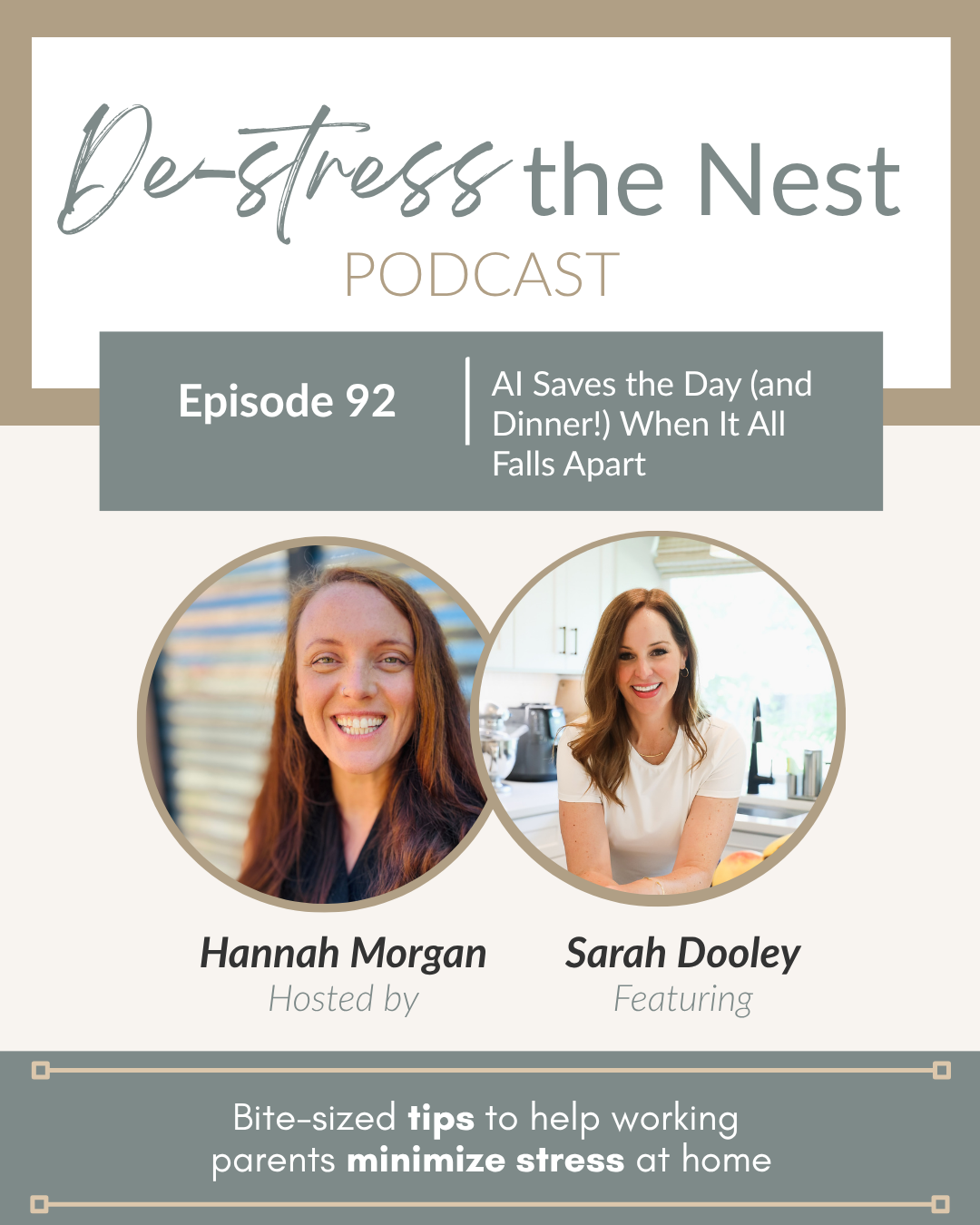
Meal planning isn't usually the hardest part of getting dinner on the table—it's what happens when the plan falls apart.
In this episode of De-Stress the Nest, Hannah Morgan sits down with Sarah Dooley, founder of AI Empowered Mom, to discuss how AI can help busy families solve dinner emergencies in real time. Instead of stressing over forgotten ingredients, last-minute schedule changes, or another takeout night, Sarah shares practical ways to use AI tools you already have to create meals with what's already in your kitchen.
From snapping a photo of your fridge to using live video assistance while cooking, this episode explores how AI can reduce mental load, save money, minimize food waste, and make family logistics just a little easier.
Key Takeaways
AI isn't just for planning—it can help solve problems when plans fall apart.
Give AI context about your family's preferences, allergies, and routines for more personalized recommendations.
Most families already have powerful AI tools available on their phones today.
AI can help reduce food waste by creating meals from ingredients you already have.
Features like live camera assistance can provide real-time help while cooking.
Quotes
"Let AI rescue you when your meal plan falls apart."
"A picture can say a thousand words."
"The mental load gets heaviest when the best-laid plans go awry."
"Nothing is too small to share with AI while being mindful of your data privacy and security."
"It's something that's very painful for parents and something AI is really good at."
Resources Mentioned
AI Empowered Mom – Practical AI education, tools, and resources designed to help busy families reduce mental load and simplify everyday life.
Heron House Management - Virtual house management for busy families: we handle your to-dos so you can focus on what matters most. Learn more at www.heronhousemanagement.com.
ChatGPT (OpenAI)
Claude (Anthropic)
Google Gemini
Microsoft Copilot
If you enjoyed this episode, please subscribe and leave a review on Spotify, iHeartRadio, Apple Podcasts or your favorite podcast platform. Your feedback helps us reach more listeners and continue to bring you valuable content!
Episodes Released Weekly on Tuesdays
This episode of De-Stress the Nest is sponsored by Heron House Management. Learn more at www.heronhousemanagement.com.
About Heron House Management:
Heron House Management is a virtual house management service that takes the stress out of your busy life by taking on your mental load and managing your To Do list. We provide fractional virtual house management for busy families at 10, 15 and 20+ hours/month.
Meal planning, signing up for kids activities, scheduling doctor's appointments, finding a house cleaner, planning your kid's birthday party, getting quotes for that home renovation project, or scheduling a monthly date night with your significant other and so much more. We do it all! Learn more at www.heronhousemanagement.com.
About Hawkeye Focus Coaching:
Hawkeye Focus Coaching helps ADHD executives, entrepreneurs, and busy professionals turn ideas into action. Through personalized, hands-on coaching, deep work sessions, accountability, and practical systems, we help clients overcome overwhelm, stay focused on what matters most, and make consistent progress toward their goals.
Whether you're launching a business, leading a team, managing a major project, or trying to get out of constant firefighting mode, Hawkeye Focus Coaching helps you work with greater clarity, confidence, and momentum. Learn more at www.hawkeyefocuscoaching.com.
-
[00:02] Hannah Morgan:
Welcome to De-Stress the Nest, a podcast for busy parents where experts share bite-sized tips on how to create systems that minimize stress at home. I’m your host, Hannah Morgan.[00:14] Hannah Morgan:
Today’s episode is sponsored by Heron House Management, the first-ever virtual house management service that lightens your mental load by handling your to-do list with monthly subscriptions of 10, 15, and 20+ hours per month. From meal planning and doctor’s appointments to birthday parties and home projects, Heron House Management helps busy families reclaim their time and live their best lives. Learn more at heronhousemanagement.com.[00:45] Hannah Morgan:
Sarah, I'm so excited to welcome you to the show today. Let's start by hearing a little bit about who you are and what you do.[00:53] Sarah Dooley:
Thank you so much for having me, Hannah. I am the founder of AI Empowered Mom, where I help parents and caregivers lighten the mental load of modern life with safe, responsible AI assistance for families. I spent 20 years working in technology and consulting, and I took all that I learned from digital transformation and AI work there and helped bring it to families.[01:10] Sarah Dooley:
And I have a book coming out next year, a podcast, and a weekly newsletter, all in the name of AI for Families.[01:17] Hannah Morgan:
Amazing. We love it. Thank you so much for sharing today. We're so looking forward to this conversation.[01:23] Sarah Dooley:
Oh, me too. I'm thrilled.[01:26] Hannah Morgan:
Sarah, today we're going to talk about meal planning. You're going to walk us through how AI can be your best friend when it comes to meal planning. I love this. It's such a source of strain and tension and exhaustion. And the question of what's for dinner, we all know, is the worst six words to hear every night. So let's talk about some AI solutions and what you've found can be helpful.[01:45] Sarah Dooley:
I think you all probably already know that AI can help you generate a weekly meal plan or even a monthly meal plan and adapt it for your grocery store or your family's dietary needs. But even the best-laid plans still fall by the wayside with today's busy families. So my tip for today is to let AI rescue you when your meal plan falls apart. And this happens to me more than I would like to admit as a founder of AI Empowered Mom. But when I forget to defrost or I'm running late, I just snap a photo of what's in my fridge and what's in my pantry and ask AI, knowing everything it knows about our family given the context that it has, what can we make to get on the table in 30 minutes or less?[02:21] Sarah Dooley:
Not only does it help me reduce food waste and save money because I'm saving on takeout and using what I have on hand, which is a little bit of a sustainability kick, but it also brings into play some learning, some new recipes and techniques, and gives me some things that I wouldn't think about in my normal go-to breakfast-for-dinner emergency repertoire.[02:38] Hannah Morgan:
I love that because it saves you that advanced planning that can feel so daunting and overwhelming. And sometimes you're just like, I need a solution right now. Let's talk about what tools you like to use to facilitate this. You say throw it into AI. What does that mean on a very practical level?[02:53] Sarah Dooley:
Any generative AI tool made by one of the major AI tool makers. So I'm talking ChatGPT from OpenAI. I'm talking Claude from Anthropic, Gemini from Google, and Microsoft Copilot. Any of these big-name AI tools are multimodal, which means they can take in data in different forms. They understand what's in a photo and can analyze that using image processing. Or you could stand in front of your fridge and use your voice, say the things that you have and what you would like to cook.[03:16] Sarah Dooley:
Taking advantage of that multimodal nature using any AI tool can help you rescue those dinner and meal-plan emergencies. There are also a lot of great tools targeted to meal-planning assistance that you can use. And of course, I have built my own AI assistant that helps rescue dinner emergencies. Its name is M, short for empowered, and we're testing with a few families right now, but there's a waitlist on my website.[03:35] Hannah Morgan:
Amazing. So tell me about how you teach AI tools to understand your preferences. What kind of setup does this require?[03:42] Sarah Dooley:
Anyone can teach AI to understand your dietary preferences, your picky family members' restrictions, and what you want to keep in mind when you're building your meal plan or navigating those surprise meal-planning disasters.[03:52] Sarah Dooley:
You can either tell AI to add it to memory. It usually requires a paid subscription or a paid license for AI to really remember you. That means you have to sign in and likely pay a monthly fee. You can also put it in your instructions. Any of these general AI tools that I mentioned also have a place where you can tell it a little bit about you. And that's a great place to say, okay, in my family we have a nut allergy, so every meal has to be nut-free.[04:16] Sarah Dooley:
We have one person who is deadly opposed to mushrooms and peas, so never say the word mushroom or pea to me. Whatever it is about your family, nothing is too small to share with AI while being mindful of your data privacy and security.[04:28] Hannah Morgan:
I love that. So you can just say, okay, here's my preferences. Here's what I've got. Let's make it happen in under 30 minutes. Can AI teach me how to make dinner in under four minutes? Because that's really my attention-span limit here. I'm not going to lie.[04:42] Sarah Dooley:
Snack dinner![04:44] Hannah Morgan:
Exactly. Yes. Waffles, please. That's awesome. So tell us about how you discovered this was the gap. You talked about how meal plans are out there. They're proactive. They give you the big picture of what you're doing for the week. Everything falls apart. How did you identify that was a gap for other consumers and that it really needed a solution in the tool you're building?[05:01] Sarah Dooley:
Hannah, just like you, I talked to over 100 families about where life gets heavy, where technology supports them, and many families already have a meal-planning system put together, or at least they know how to cobble one together. But the mental load gets heaviest when the best-laid plans go awry, so that's why this is something that I focus on.[05:18] Sarah Dooley:
Plus, the superpower of AI is that multimodal nature, and you don't always want to go and type in a really long prompt. Instead, you can use a picture to say a thousand words, and it just feels like a sweet spot where it's something that is very painful for parents and something that AI is really good at. So it's a tip I love to share with families.[05:36] Hannah Morgan:
You know, I'm really big into voice-to-text. It's been my savior. My kids actually don't understand that texting is something that happens with your fingers because I speak into my phone constantly. So every once in a while, they're too young to really understand Google. They'll just walk over to my phone and say, "Hey, how many toes does a penguin have?" because they don't understand the microphone piece.[05:55] Hannah Morgan:
But I watched a client recently use ChatGPT's audio feature, and I thought, wow, I wish more people understood exactly how accessible it is to have this incredible tool in your pocket that you can use for so many things. Multimodal was the term that you used. Are there other examples of how there's maybe a solution in your pocket you didn't realize could solve everyday problems? Meal planning and, oh, what's for dinner? Meal plan went out the window is one really great example. Do you have a couple others that might be easily solvable?[06:20] Sarah Dooley:
I have one more that is related to meal planning. You know when you're making a recipe that you've never made before or trying something new and it doesn't just feel quite right?[06:29] Sarah Dooley:
With Google Gemini, the AI tool from Google, they have a feature called Go Live, and other AI tools have this. But Google Gemini is the one that is my go-to. Recently I was trying to make empanadas from scratch for a family event, and I knew it wasn't going right in the way that I was folding it. You can hit Go Live with Gemini and show it, this is the way that I'm folding this, and it's falling apart.[06:50] Sarah Dooley:
Gemini will talk right back to you. What it told me was, "Oh, I see you're trying this technique, but you're not pinching the edges." So it could actually see what I was doing live. Now, it is a computer that is making a prediction based on the data that it was trained on, but in that moment I had all the ingredients, all this investment, time pressure, and I knew that I wasn't folding this just right.[07:11] Sarah Dooley:
Sometimes it's like, how is this supposed to look on the plate? What has gone wrong with this? Can I serve this to my family or to guests? You can go live with an AI tool like Gemini, and it can look at what you're working on through the camera and then speak back to you. So, taking advantage not just of voice mode, but voice plus video.[07:29] Hannah Morgan:
Amazing. I like what you said earlier, and I want to roll back to when you said the problem solving and when things fall apart is this unexpected layer of the mental load. Best-laid plans, right? It all goes out the window when something happens.[07:42] Hannah Morgan:
But the other thing this is really bringing to mind for me is how this is a game changer for people with disabilities, to be able to maybe see things that they wouldn't be able to with their own eyes. And I think there are so many applications for AI that maybe we wouldn't have expected. We start applying it to our own life and then realize it can open up the world for so many more people.[08:02] Hannah Morgan:
So I hope our listeners consider that this is something accessible to you in your back pocket, but maybe also to your aging parents who might have a little trouble reading recipes under low light or whatever the application may be. I'm definitely going to have to activate that Go Live feature because I feel like there are plenty of times when my recipes go south. So that's a really great way of using it. Thanks for sharing.[08:23] Hannah Morgan:
Thanks for sharing, Sarah, and for all of your insights.[08:27] Sarah Dooley:
Thanks so much, Hannah. I love to talk about this.[08:31] Hannah Morgan:
All right, it's time for a recap. Takeaway one: AI is there for not just the planning, but also the problem solving. Leverage it when your plans go out the window and you need a solution quickly before you reach for takeout.[08:42] Hannah Morgan:
Takeaway two: Give AI context. The more information you can give AI without violating your privacy, the more helpful it can be. Uploading your family's dietary needs, preferences, and routines can give you an even more valuable output.[08:53] Hannah Morgan:
Takeaway number three: Use the tools that are already in your pocket. You've got a bunch of them, and many of them are free. You can access them from your phone: Claude, ChatGPT, Gemini, and plenty more.[09:04] Hannah Morgan:
Takeaway number four: Progress beats perfection. It doesn't have to be perfect; it just has to be edible, on the table, and hopefully provide minimal stress.[09:12] Hannah Morgan:
And takeaway number five: Use this tool to help you reduce stress and reduce waste. Using AI to build a meal out of ingredients you already have saves a trip to the store and prevents unnecessary food waste from that zucchini that's rotting in the back of your fridge.[09:25] Hannah Morgan:
Thanks for listening to De-Stress the Nest, the podcast where experts share bite-sized tips on how to minimize stress at home. Don't forget to subscribe and tune in every Tuesday for more ways to simplify your life.
