
Episode 91 – True Self Care for Overloaded Parents with Ajantha Suriyanarayanan
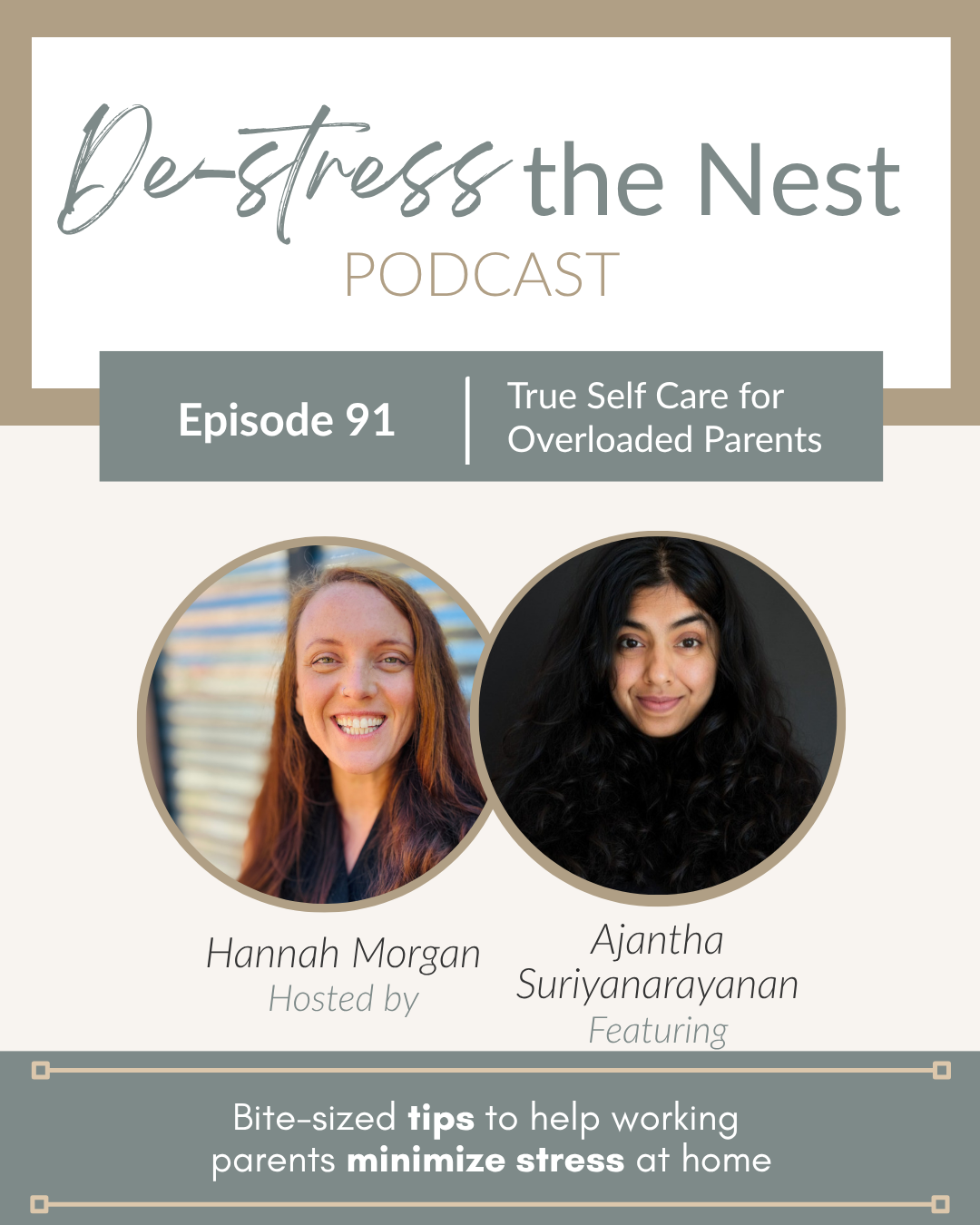
Self-care isn't just bubble baths and spa days. For busy parents, it's about creating the mental space to care for yourself before burnout becomes your default.
In this episode of De-Stress the Nest, Hannah Morgan sits down with Ajantha Suriyanarayanan, founder and CEO of Mental Load, to explore why self-care consistently falls to the bottom of the priority list for working parents—and how technology, systems, and intentional habits can help change that.
Ajantha shares why self-care is essential for maintaining your mental health, how sharing the mental load at home creates more balance, and why even small moments of restoration can make a significant difference for both parents and their families.
Whether your version of self-care is reading a book, taking a walk, exercising, or simply enjoying a hot cup of tea before the chaos begins, this episode offers practical encouragement to prioritize yourself without guilt.
Key Takeaways
Self-care looks different for everyone—and it doesn't have to be elaborate.
You can't continue caring for everyone else if you're constantly running on empty.
Building self-care into your schedule is more effective than hoping time magically appears.
Sharing household responsibilities creates space for both partners to recharge.
Technology and intentional systems can help reduce mental load and prevent burnout.
Quotes
"Self-care is whatever we need to do for ourselves to make sure that we are able to maintain our sanity, our health, and that we are acknowledging ourselves as a person."
"Women put self-care at the bottom of the bottom of the list."
"Everything they need to do for others is swirling so much around their heads that they don't have the mental space or the brain space to make time for this."
"Without self-care, we are burning ourselves out to a point where we can't give to others that we love and care about so much."
"This has got to come up really high on the list."
Resources Mentioned
Mental Load – AI Companion for Life Management - A tech platform designed to help families delegate seamlessly, automate reminders, and reduce the cognitive load of managing home life.
Heron House Management - Virtual house management for busy families: we handle your to-dos so you can focus on what matters most. Learn more at www.heronhousemanagement.com.
Working Moms Movement - Coaching and practical systems that help working moms reduce overwhelm, reclaim their time, and create a life that actually works.
If you enjoyed this episode, please subscribe and leave a review on Spotify, iHeartRadio, Apple Podcasts or your favorite podcast platform. Your feedback helps us reach more listeners and continue to bring you valuable content!
Episodes Released Weekly on Tuesdays
This episode of De-Stress the Nest is sponsored by Working Moms Movement, a coaching and system-based program designed to help working moms stop living in survival mode and start building a life that actually works.
Learn more at www.workingmomsmovement.com.
About Heron House Management:
Heron House Management is a virtual house management service that takes the stress out of your busy life by taking on your mental load and managing your To Do list. We provide fractional virtual house management for busy families at 10, 15 and 20+ hours/month.
Meal planning, signing up for kids activities, scheduling doctor's appointments, finding a house cleaner, planning your kid's birthday party, getting quotes for that home renovation project, or scheduling a monthly date night with your significant other and so much more. We do it all! Learn more at www.heronhousemanagement.com.
About Hawkeye Focus Coaching:
Hawkeye Focus Coaching helps ADHD executives, entrepreneurs, and busy professionals turn ideas into action. Through personalized, hands-on coaching, deep work sessions, accountability, and practical systems, we help clients overcome overwhelm, stay focused on what matters most, and make consistent progress toward their goals.
Whether you're launching a business, leading a team, managing a major project, or trying to get out of constant firefighting mode, Hawkeye Focus Coaching helps you work with greater clarity, confidence, and momentum. Learn more at www.hawkeyefocuscoaching.com.
-
[00:00] Hannah Morgan: Welcome to De-Stress the Nest, a podcast for busy parents where experts share bite-sized tips on how to create systems that minimize stress at home. I'm your host, Hannah Morgan.
[00:12] Hannah Morgan: Today's episode is sponsored by the Working Moms Movement, a coaching and system-based program designed to help working moms stop living in survival mode and start building a life that actually works. Through a combination of personalized coaching and building practical real-life systems, Working Moms Movement helps you reduce overwhelm, reclaim your time, and feel more present in both your career and your family without having to sacrifice one for the other. So if you've ever felt like you're doing everything right but still feel constantly behind, this is for you. You can learn more at workingmomsmovement.com.
[00:37] Hannah Morgan: Ajontha, I'm thrilled to have you on the show today, so let's start by talking a little bit about who you are and what you do.
[00:44] Ajantha Suriyanarayanan: Lovely to be here, Hannah. Thank you for inviting me. My name is Ajamta Surinaranen. By training, I'm a behavioral researcher and product strategist.
[00:53] Ajantha Suriyanarayanan: Currently, I'm the founder and CEO of Mental Load. It's an agent AI companion for stress-free life management. We've all been there, working mom, default parent for two little kids who are… whom I call my adorable rats, enormous demands at work, in leadership roles.
[01:11] Ajantha Suriyanarayanan: while climbing my career, my corporate ladder was brilliant, it also left me burnt out. And I went looking for a tech solution that would help me manage my life a little bit better, and reduce the degree of mental load I was carrying on a day-to-day basis.
[01:25] Ajantha Suriyanarayanan: didn't find one, so like any good person that's worked in tech before does, I've decided to build my own, and that's where we are.
[01:33] Hannah Morgan: Fantastic, thanks for joining us today, we're excited.
[01:37] Ajantha Suriyanarayanan: Thank you for having me.
[00:37] Hannah Morgan: So, Ajantha, we're going to talk today about something that is,
[00:42] Hannah Morgan: It's a tough topic, self-care, right? Because there's a lot of stigma around what self-care can mean, especially for women, especially for busy women, and we have this notion that's very dated of bubble baths and me time, and it's so much more than that. So, let's talk about your perspective on self-care, why it's important, and how we can make sure that it's baked into our daily lives.
[01:05] Ajantha Suriyanarayanan: Absolutely. Hannah, this is such an important topic, and one that's really, really close to my heart, because self-care among women is rated as one of the lowest priorities, which is really unfortunate. Women are running, their workloads, they're running their household loads.
[01:23] Ajantha Suriyanarayanan: and do so much for so many other people, and guess who's at the bottom of the list? Not themselves. They are further bottom of the bottom of the list. That's where women put self-care. And you're absolutely right. We have these dated ideas about what self-care means.
[01:40] Ajantha Suriyanarayanan: You and I talked earlier about, the kind of books we were reading.
[01:45] Ajantha Suriyanarayanan: To me, personally, reading a book is a form of self-care, because it's either an intellectual engagement, a form of learning to improve myself, or just a way to wind down from everything else you're doing for everyone else.
[01:58] Ajantha Suriyanarayanan: going for a run, or, assuming a fitness class, going to yoga, whatever it is, meditation. Self-care is…
[02:07] Ajantha Suriyanarayanan: Whatever we need to do for ourselves to make sure that we are able to maintain our sanity, our health, and that we are acknowledging ourselves as a person, as a human, who lives in this household.
[02:19] Ajantha Suriyanarayanan: And women needing to do this more is not for a want of doing it or a commitment, it's just that
[02:28] Ajantha Suriyanarayanan: Everything that they need to do for others is swirling so much around their heads that they don't have the mental space or the brain space to make time for this.
[02:40] Ajantha Suriyanarayanan: I can't tell you how many women have told me that they have a bit of, I'm doing air quotes here, downtime, and the downtime is filled with a run to the grocery store.
[02:52] Ajantha Suriyanarayanan: or is filled with a run to the kids' soccer practice where they left their water bottles the day before. That is not self-care, that is not downtime, that is continually doing something for someone else.
[03:05] Ajantha Suriyanarayanan: I want to help bring it up higher on the list, way higher up on the list. There are platforms that enable us to manage our calendars, like Motion or Notion, that will enable you to, modify your daily schedules.
[03:21] Ajantha Suriyanarayanan: such that you can prioritize what's relevant for you. As we've talked about this earlier, my team and I, we're building Mental Load, which is an agent to get a companion to de-stressed life.
[03:35] Ajantha Suriyanarayanan: A component of de-stressing life is putting self-care higher up on the list. So, the way we're building it.
[03:43] Ajantha Suriyanarayanan: His mental load is able to look at your calendar, your list of to-dos, your partner's calendar, partner's list of to-dos, and if, let's say.
[03:52] Ajantha Suriyanarayanan: Your partner has the ability to take your kid to soccer practice today, so that you can use those 30 minutes to go for a quick run, or to have a calming moment.
[04:04] Ajantha Suriyanarayanan: to do whatever it is that you need to do, then Mental Load is going to come up and suggest to you, hey, would you like me to move this to your partner's list of to-dos instead of keeping it in your list of to-dos, so that you get a bit of decompression time? He does have decompression time, I've made sure of that in his calendar, now I want to make sure of it on your calendar.
[04:22] Ajantha Suriyanarayanan: Now, what this does is equalize what each person is doing in the household that both partners are able to support the family the way they need to, while still not sacrificing their own personal time.
[04:38] Ajantha Suriyanarayanan: Women, especially, we need to ingest that This
[04:44] Ajantha Suriyanarayanan: degree of self-care that we're giving ourselves today is simply not sufficient from a perspective of how much we can run on an empty tech. So, let's bring it higher up on the list, and we need to prioritize it.
[04:56] Hannah Morgan: And the tool that you're building is really going to be pushing that issue, and asking… not even asking the hard questions, telling you, hey, you're… you need to do something for yourself, because if it's up to you, you're not going to do it, or if you do, it'll be in service to others. And I find that that is just a tragedy, right? Where we're not really investing in ourselves, and we can… we just keep pouring and keep emptying the cup, and it's never refilling.
[05:21] Hannah Morgan: And so I'm so glad to hear that we're using these forces for good to not just rebalance things at home, and to not just take things off our plate, but to also reinforce that your time is extremely valuable, and you have to find a way to restore and do what's valuable to you, what gives you purpose, and what gives you meaning. I think that's such a beautiful thing. So I'm curious about what your own experience was that
[05:45] Hannah Morgan: Helped you realize that this is something that not only maybe you needed to prioritize, but that others systemically do, and how self-care plays a role in our ability to operate as working parents?
[05:58] Ajantha Suriyanarayanan: Oh, absolutely. You cannot pour from an empty cup is a… is a great saying. And I'm glad you asked, because my personal experience is,
[06:07] Ajantha Suriyanarayanan: never stop running, right? You're always on the go. From the moment you wake up, till the moment you go to bed, it's…
[06:15] Ajantha Suriyanarayanan: Get the family ready for the day, push yourself, meeting, meeting, meeting, evening classes or after-school, curricula for both the kids, in my case. And then, once they, go to bed, log back on, work again.
[06:30] Ajantha Suriyanarayanan: I can't tell you, Hannah, how many days I have spent where I have literally forgotten that I needed to have lunch. It's just slipped my mind. It's not something that's physical any longer. The mental confidence has gone missing. And there came a time where my mental health got affected. My physical health got affected.
[06:49] Ajantha Suriyanarayanan: And it wasn't a sustainable option any longer, because I would like to be active, healthy, and completely involved for both my kids.
[06:59] Ajantha Suriyanarayanan: And so… I…
[07:03] Ajantha Suriyanarayanan: turn to my partner. I happen to have a partner who's completely engaged and completely supportive, we're equal in every which way. And, there was this human pushing me to say, no, you're gonna go do yoga, because that's your wind-down activity, so go. I can move my meetings around, so I can take the kids for their ballet lessons.
[07:23] Ajantha Suriyanarayanan: great, that worked out brilliantly for me. But I'm also aware, very consciously, that not everyone has the luxury of a partner moving their meetings around and being able to tackle what this individual needs to tackle. And that's…
[07:39] Ajantha Suriyanarayanan: why we're creating this product within mental load, where we're saying, we know that socio pressures, your own mental pressures, will
[07:50] Ajantha Suriyanarayanan: push you to keep going, to keep doing stuff for others, but we are here for you. And this product is going to be here for you so that it can tell you, hey, you're doing a lot. Would you like a moment to breathe?
[08:05] Ajantha Suriyanarayanan: And, that might include something as simple as you make your cup of tea at 7 in the morning, finish it by 7.10, without reheating it 4 times and finishing at 3pm.
[08:17] Hannah Morgan: Oh yeah, that's the story of the working parent, right? Always at the microwave.
[08:21] Ajantha Suriyanarayanan: Yes.
[08:23] Hannah Morgan: That's great. Well, I'm glad to hear that you're building this in systemically, because hopefully that will be the start of a shift of how we can really assume that self-care needs to be baked in every day. I love that. Thank you.
[08:35] Ajantha Suriyanarayanan: Absolutely, and I hope, more people will join on this quest to put themselves on the list, anywhere, somewhere on the list, not at the very bottom, because without self-care.
[08:46] Ajantha Suriyanarayanan: we are burning ourselves out to a point where we can't give to others, that we love and care about so much. So, this has got to come up really high up on the list.
[08:56] Hannah Morgan: Yeah, love that. Alright, thanks for sharing, appreciate it, Jonatha, this is great.
[09:01] Ajantha Suriyanarayanan: Thank you for having me here.
[10:11] Hannah Morgan: Thanks for listening to De-Stress the Nest, the podcast where experts share bite-sized tips on how to minimize stress at home. Don't forget to subscribe and tune in every Tuesday for more ways to simplify your life.
