
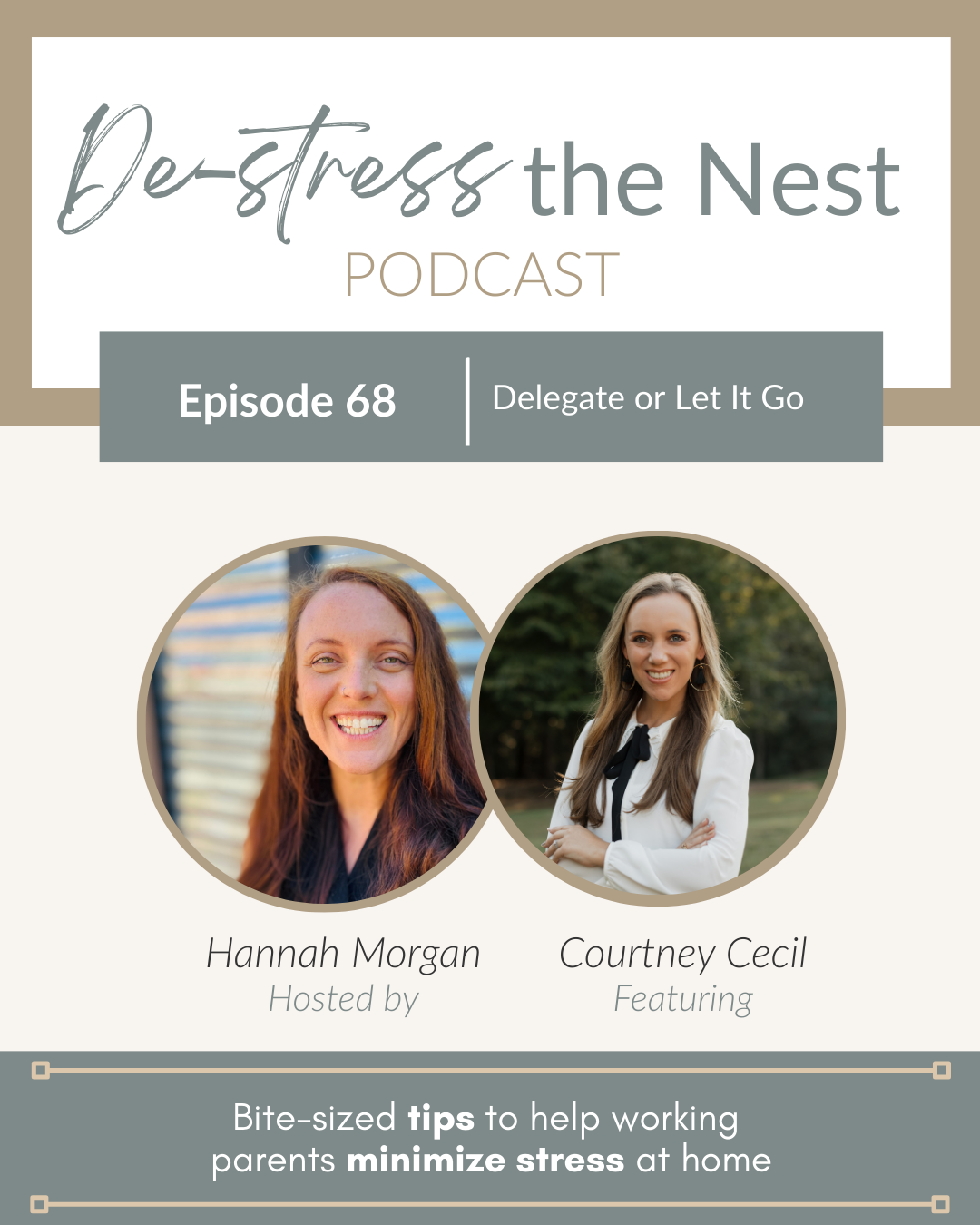
Episode 68: Delegate or Let it Go with Courtney Cecil
Delegation isn’t just a workplace skill—it’s one of the most powerful tools for reducing stress at home, too.
In this episode of De-Stress the Nest, Hannah Morgan sits down with Courtney Cecil, a Fortune 50 executive, founder of Working Moms Movement, and mom of three, to talk about how delegation can radically change your relationship with time, energy, and mental load.
Courtney challenges the idea that delegation always requires money or outsourcing. Instead, she walks us through a framework for deciding what truly needs to be done by you, what can be shared, and what might not need to be done at all. She also introduces creative, community-based solutions—like soup swaps—and reminds us that our kids can (and should) be part of the support system too.
This episode is about more than handing off tasks. It’s about protecting what you value, letting go of what drains you, and building sustainable systems that support the life you actually want.
Key Takeaways
Delegation is a time freedom skill. The higher you rise at work, the more you delegate—so why not use the same strategy at home?
Not everything needs to be done. If a task isn’t aligned with your values, it may not be worth delegating at all—sometimes the best choice is to let it go.
Ask better questions about your to-do list. Is this something only I can do? Do I enjoy it? Does it actually matter?
Delegation doesn’t have to cost money. Community-based systems like soup swaps or shared childcare can be just as powerful as paid help.
Your kids are part of your support system. Teaching children responsibility is a life skill—and a long-term investment.
Delegation protects what you value. When you offload draining tasks, you make space for presence, connection, and rest.
Quotes
“Delegation is one of the most underutilized skills for finding time freedom at home.”
“Just because something needs to be done doesn’t mean you need to be the one to do it.”
“If it’s not something you value, maybe it doesn’t even need to be done.”
“Delegation doesn’t always cost money—sometimes it just takes creativity.”
“You train and grow your team at work. You can do the same at home.”
“Our kids should be part of the solution, not extra work for us.”
“Delegation gives you time, but it also gives you peace.”
Resources Mentioned
Working Moms Movement – Courtney’s coaching and programs
The Life Management System for Working Moms – Courtney’s podcast
Heron House Management – Virtual house management for busy families: we handle your to-dos so you can focus on what matters most.
Subscribe & Leave a Review:
If you enjoyed this episode, please subscribe and leave a review on Spotify, iHeartRadio, Apple Podcasts or your favorite podcast platform. Your feedback helps us reach more listeners and continue to bring you valuable content!
Episodes Released Weekly on Tuesdays
This episode of De-Stress the Nest is sponsored by Heron House Management.
About Heron House Management:
Heron House Management is a virtual house management service that takes the stress out of your busy life by taking on your mental load and managing your To Do list. We provide fractional virtual house management for busy families at 10, 15 and 20+ hours/month.
Meal planning, signing up for kids activities, scheduling doctor's appointments, finding a house cleaner, planning your kid's birthday party, getting quotes for that home renovation project, or scheduling a monthly date night with your significant other and so much more. We do it all!
-
[00:00] Hannah Morgan:
Welcome to De-Stress the Nest, a podcast for busy parents where experts share bite-sized tips on how to create systems that minimize stress at home. I'm your host, Hannah Morgan.[00:12] Hannah Morgan:
Today’s episode is sponsored by Heron House Management — the first-ever virtual house management service that lightens your mental load by handling your to-do list with monthly subscriptions of 10, 15, and 20+ hours per month. From meal planning and doctor’s appointments to birthday parties and home projects, Heron House Management helps busy families reclaim their time and live their best lives. Learn more at heronhousemanagement.com.[00:38] Hannah Morgan:
Courtney, I'm so excited to have you on the show today. Let’s start by hearing a little bit more about who you are and what you do.[00:46] Courtney Cecil:
Well, Hannah, first of all, thank you so much for having me and for all the work you’re doing to support working parents out there. Greetings from Charlotte, North Carolina. I’m the proud wife and mom to three boys — ages eight, nine, and eleven.In addition to that, I’m a Fortune 50 executive, the founder of a company called Working Moms Movement, where I help working moms go from stretched thin and stuck in their to-do lists to totally in control and fully present for what matters most — both at work and at home. I’m also the host of the Life Promotion System for Working Moms podcast.
[01:34] Hannah Morgan:
Amazing. I’m so glad to have you here today. Thanks for sharing your wisdom and for all the work you do.[01:44] Hannah Morgan:
Courtney, I’m excited to talk with you about delegation. As you know, this is at the core of what we do at Heron House Management — helping our clients understand what’s important, what to let go, and how to let it go. So let’s talk about the role that delegation plays in being successful at home and at work.[02:06] Courtney Cecil:
Delegation is one of the most underutilized skills when it comes to finding time freedom at home. We do this all the time at work — the higher you go in an organization, the more you delegate. So why wouldn’t we capitalize on that same skill at home?And the first thing I want people to know is that delegation doesn’t always cost money. It doesn’t have to be expensive — sometimes it can be completely free.
When I work with clients, I challenge them to ask a few key questions about every task they do:
Does this have to be me?
Could someone else do it just as well — or better?
Do I enjoy this?
Do I actually value doing it, or do I just value that it gets done?And then the big one: does anyone even need to do this at all?
Sometimes the best choice isn’t delegation — it’s elimination.
[03:32] Hannah Morgan:
Yes. One of the first things we ask our clients to do is take a casual tally of everything they manage in a week. And then ask: do I enjoy this? Is it valuable? Could someone else do it? Could someone else do it better?That last one is hard for people. We’re so conditioned to think, “Well, I can do it,” instead of, “Is this the best use of my time?” We wouldn’t design our own logo instead of hiring a graphic designer — so why do we do that with everything else in our lives?
[04:21] Hannah Morgan:
When you walk clients through this process, what kind of impact do you see?[04:28] Courtney Cecil:
It’s both a time-giver and a stress reducer. When you delegate something, you’re saying, “This task needs to get done — but it doesn’t need to be done by me.”For example, cooking. I don’t hate it, but I don’t love it either. But my kids need to eat three times a day — plus snacks. That’s a lot. So for me, cooking became a great candidate for delegation.
I value health. I value not eating out constantly. But I don’t need to be the one making every meal. By delegating that, I protect what I value and I get my time back. Instead of cooking, I get to be present with my boys — hearing about their day, helping with schoolwork, just being there.
[05:54] Hannah Morgan:
I had a professor in college who used to say, “I make the bacon. I shouldn’t have to cook it.” I love that.Let’s talk logistics. What are some creative ways people can actually do this — without it becoming expensive or overwhelming?
[06:13] Courtney Cecil:
This really depends on your resources and creativity. Most people assume delegation always means hiring someone — but it doesn’t.One of my favorite ideas is a “soup swap.” You get a few families together. Each week, one person cooks a double batch. Everyone gets a container. So you only cook once every few weeks — but you’re fed every week.
[06:48] Hannah Morgan:
I have always wanted to do this. I love it.[06:51] Courtney Cecil:
It’s simple, it’s communal, and it’s low-cost. Delegation can come from your village. It doesn’t have to be a paid service.And another thing people forget: your kids can be part of the solution. Delegation isn’t just about adults. Kids can help from a very young age. It’s a life skill.
We often take on everything ourselves because it feels easier — but teaching kids to help is an investment. Just like at work, you train your team. You have to train your team at home too.
[08:01] Hannah Morgan:
That’s such a perfect analogy — building your team. It takes time, but it pays off.I love this conversation. I hope people try soup swaps, neighborhood systems, and creative solutions — not just outsourcing everything, but rethinking how they share the load.
Thank you so much for sharing this, Courtney.
[08:36] Courtney Cecil:
Thank you for having me, Hannah.[08:41] Hannah Morgan:
Thanks for listening to De-Stress the Nest — the podcast where experts share bite-sized tips on how to simplify your life. Don’t forget to subscribe and tune in every Tuesday for more ways to make home feel easier.