
Episode 69: Make Your Calendar Your Superpower with Amy Briggs
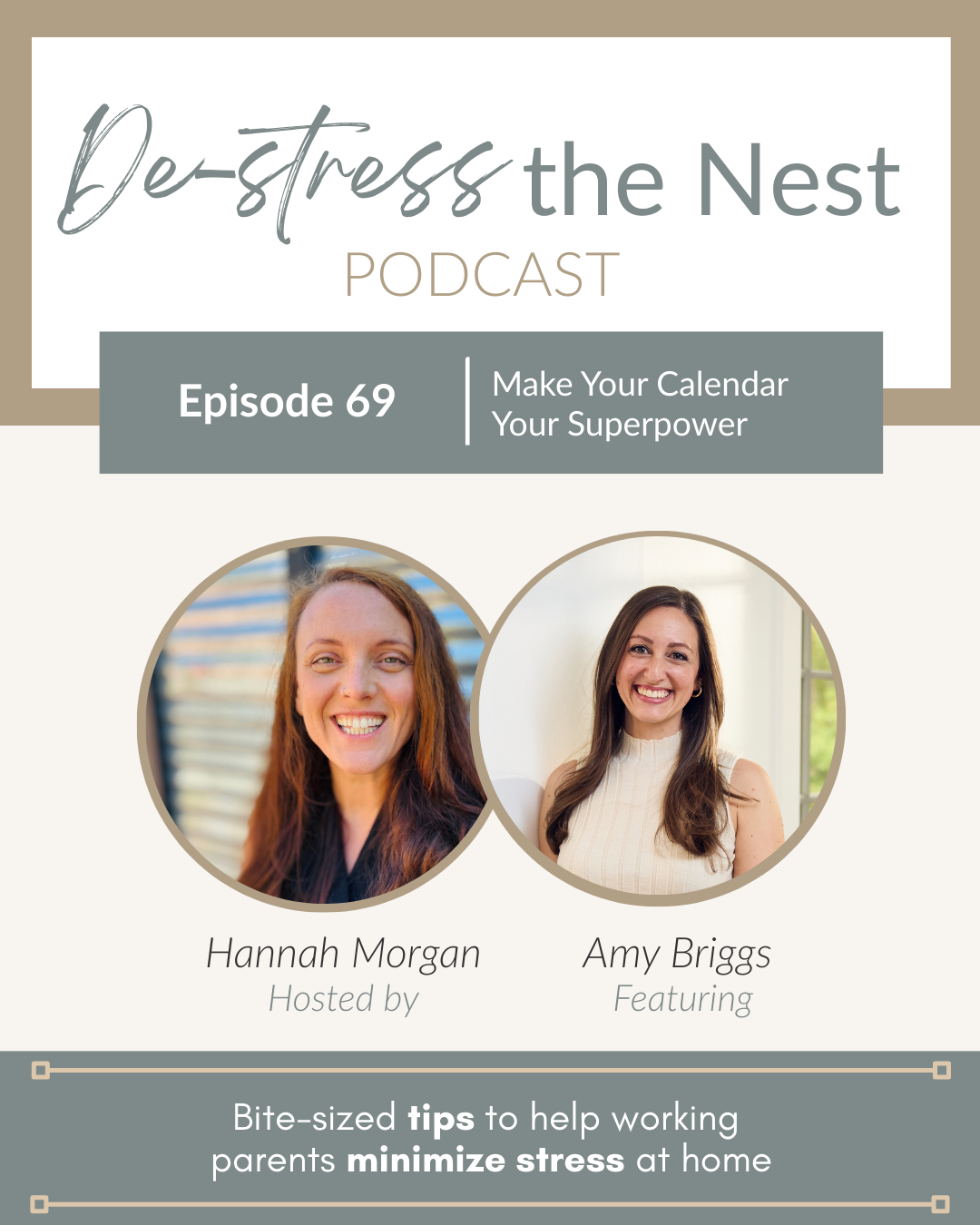
Managing a busy family calendar can feel like a full-time job — but it doesn’t have to live in your head.
In this episode of De-Stress the Nest, Hannah Morgan sits down with Amy Briggs, mom of two, speech-language pathologist, and founder of Aviva, to talk about how turning your calendar into a true family command center can reduce mental load, improve communication, and make daily life feel more manageable.
Amy shares why getting everything onto a shared calendar — from school events to small prep tasks — helps families stop relying on memory and start relying on systems. She also explains how intentional calendar use creates more partnership at home and fewer last-minute scrambles.
This episode is about more than scheduling. It’s about protecting your bandwidth, sharing responsibility, and creating systems that support the life you actually want.
Key Takeaways
If it’s living in your head, it’s costing you energy. Tasks and reminders that never make it onto a calendar quietly drain your bandwidth all day.
A full calendar can reduce stress. Seeing everything in one place helps you make intentional decisions instead of reacting to forgotten details.
Shared calendars are about partnership, not control. A system only works if both partners buy in and use it consistently.
More things are “calendar-worthy” than you think. Prep time, transitions, follow-ups, and logistics all affect family life and deserve a spot.
The goal is less mental load, not more steps. A good system removes jobs from your brain instead of repackaging the same invisible work.
Systems create presence. When your calendar holds the details, you’re free to focus on connection, work, and rest.
Quotes
“If it’s living in your head, it’s costing you bandwidth all day long.”
“A full calendar can actually reduce stress — because you finally see what you’re carrying.”
“Shared calendars aren’t about control. They’re about partnership.”
“We’re too busy to be busy with our calendars — that’s why systems matter.”
“The goal isn’t a prettier planner. The goal is less mental load.”
Resources Mentioned
Aviva – Amy Briggs’ family calendar app that helps parents automatically turn emails into calendar events and streamline scheduling.
Heron House Management – Virtual house management for busy families: we handle your to-dos so you can focus on what matters most.
Subscribe & Leave a Review:
If you enjoyed this episode, please subscribe and leave a review on Spotify, iHeartRadio, Apple Podcasts or your favorite podcast platform. Your feedback helps us reach more listeners and continue to bring you valuable content!
Episodes Released Weekly on Tuesdays
This episode of De-Stress the Nest is sponsored by Heron House Management.
About Heron House Management:
Heron House Management is a virtual house management service that takes the stress out of your busy life by taking on your mental load and managing your To Do list. We provide fractional virtual house management for busy families at 10, 15 and 20+ hours/month.
Meal planning, signing up for kids activities, scheduling doctor's appointments, finding a house cleaner, planning your kid's birthday party, getting quotes for that home renovation project, or scheduling a monthly date night with your significant other and so much more. We do it all!
-
[00:00] Hannah Morgan:
Welcome to De-Stress the Nest, a podcast for busy parents where experts share bite-sized tips on how to create systems that minimize stress at home. I'm your host, Hannah Morgan. Today’s episode is sponsored by Heron House Management — the first-ever virtual house management service that lightens your mental load by handling your to-do list with monthly subscriptions of 10, 15, and 20+ hours per month. From meal planning and doctor’s appointments to birthday parties and home projects, Heron House Management helps busy families reclaim their time and live their best lives. Learn more at heronhousemanagement.com.[00:37] Hannah Morgan:
Welcome back to this week's episode of De-Stress the Nest. Today, I'm sitting down with Amy Briggs, who is a mom of two and a speech-language pathologist, and also the founder of Aviva — a very cool tool that helps you optimize your calendar. Now, if you're anything like me and you've got lots of people going in lots of different directions, a calendar is truly the glue that holds every family together between all of your different activities, reminders, and all the things you need to do. It can really be a central place for organizing. So Amy is going to chat with us about how you can optimize your calendar to make it work best for you, set up those automations, and relieve your mental load.[01:13] Hannah Morgan:
Amy Briggs, I'm so happy to welcome you to De-Stress the Nest. Why don't we start by hearing a little bit about who you are and what you do?[01:21] Amy Briggs:
Thank you so much for having me, Hannah. I'm so happy to be here. I am Amy Briggs. I am a mom of two daughters and a speech-language pathologist by trade, and I am the founder and CEO of Aviva, which is a new-to-market app that helps busy parents automatically turn their emails into events on their calendar — and so much more. I'm so happy to be here today.[01:42] Hannah Morgan:
Awesome, glad to have you. Thank you, Amy. So, Amy, you're going to chat with us today about your best practice for managing a busy family life between work and kids' activities and all the things, so let's talk about your secret sauce.[01:55] Amy Briggs:
Okay, I'm so excited to share this. As someone who definitely, I think, always seems like I have everything together — who, behind the scenes, does not always, as I'm sure anyone listening can relate to — something that has really helped me in my family, and something that I have seen success with in my clients as a speech pathologist, and now as a business that leverages productivity for busy parents, is making sure that everything lives on a calendar.[02:27] Amy Briggs:
And I will pause for a second, because I know for some people, that feels like potentially an addition of stress or an addition of a job. I know a lot of people like Inbox Zero. I know a lot of people like a clean calendar. I would argue, from my own experience, from research on executive functioning, and from watching app users go through various iterations of the app as we were building Aviva, that having a place for everything on your calendar really is the key secret sauce to getting rid of the mental load part that goes along with scheduling.[03:05] Amy Briggs:
If it's living in your head, if it's living somewhere in a disjointed note on your phone, if it's something you told your spouse as you were snarfing down breakfast, getting the kids' socks on, leaving the door, and just kind of screamed into the ether that you have this thing coming up, it's not probably going to reliably happen in the way that you intend it to.[03:29] Amy Briggs:
And I think the other piece is, in order to be intentional about our calendars, and to be intentional about our time — which every busy parent wishes they had more of and less stress around — you have to see what's there to know if you want to edit something. You have to see what the everything is and all the moving pieces.[03:55] Amy Briggs:
So I would advocate for scheduling really even minute details of your day if you need to. If you need to pack a bag for soccer practice, schedule packing the bag or include it in the soccer practice event with a time buffer in the notes. We do that automatically at Aviva, but you could do it yourself, too. If you’re going to have to follow up on an email, schedule that in your calendar or snooze the email so it comes back for you at a time that you set. Make it a calendar-bound activity so that that idea is not playing on your mind all day long, lowering your bandwidth and making it harder for you to really accomplish anything.[04:45] Hannah Morgan:
Yeah, I like what you said about it lowering your bandwidth, because I feel that. The mental load is something we think of kind of abstractly, but it really does feel like a weight. And when I feel like I have that thing on the tip of my tongue that I'm trying not to forget all day, it drives me crazy. I've never understood how people can live without a calendar, because once I started using one, it was such a game changer. So, let's talk about how it facilitates communication with a partner when you're using a shared digital space.[05:14] Amy Briggs:
Great question, and I think this is huge. Whatever system you choose, get everything on a calendar that both you and your partner have bought into. If you are digitizing your calendar and your partner is not willing to look at that digital calendar, you don’t actually have shared communication over it, and it's just going to be a breeding ground for bigger problems and resentment.[05:43] Amy Briggs:
So I think really having the communication first — this is a structure for our family, how are we both going to be able to effectively do this — is key. For many people, that's a shared digital calendar, but if it's not, that's okay.[05:59] Amy Briggs:
And then, whatever you can do to take the jobs away from the two or more players who input things into that calendar and streamline the process of what gets on there, the better. So maybe if you're doing it manually, that's a conversation about what is calendar-worthy.[06:23] Amy Briggs:
I need to know if my husband's going to a work event and I'm now running all the pickups. I need that on our family calendar, even though the family isn't going to the event. I need to know if there's a later work day, or he needs to know if it's a music concert he really wants to attend.[06:45] Amy Briggs:
So having a shared understanding first of where are we putting it, what's calendar-worthy for us, and then how do we take some of this workload away from ourselves? We're too busy to be busy with our calendars. How can you automate it? How can you streamline it? A great starting point is an audit — what are our systems now, and how do we want them to be better?[07:38] Hannah Morgan:
Yeah, I like what you said — what are our systems now? Because a lot of people come to us and say they don't have a system. And having that buy-in with your partner is critical, because a tool is only as good as if you actually use it.[08:18] Amy Briggs:
Exactly. I see so many products positioned toward women — who disproportionately hold this mental load — where it's like, this tool is going to change your life, but really it's just prettier packaging of the same job, or more steps. I’m not interested in jumping through any new hoops just to get us where we need to be.[09:20] Hannah Morgan:
I love that. So it's not about new hoops — it's about setting up a system that works, leverages technology where it helps, and most importantly is something you and your partner actually use together. Thank you so much for sharing, Amy. This is super helpful.[09:40] Amy Briggs:
Thank you so much for having me.[09:45] Hannah Morgan:
Thanks for listening to De-Stress the Nest — the podcast where experts share bite-sized tips on how to simplify your life. Don’t forget to subscribe and tune in every Tuesday for more ways to simplify your life.