Episode 67: How Setting Boundaries Can Set You Free with Steph Koenig
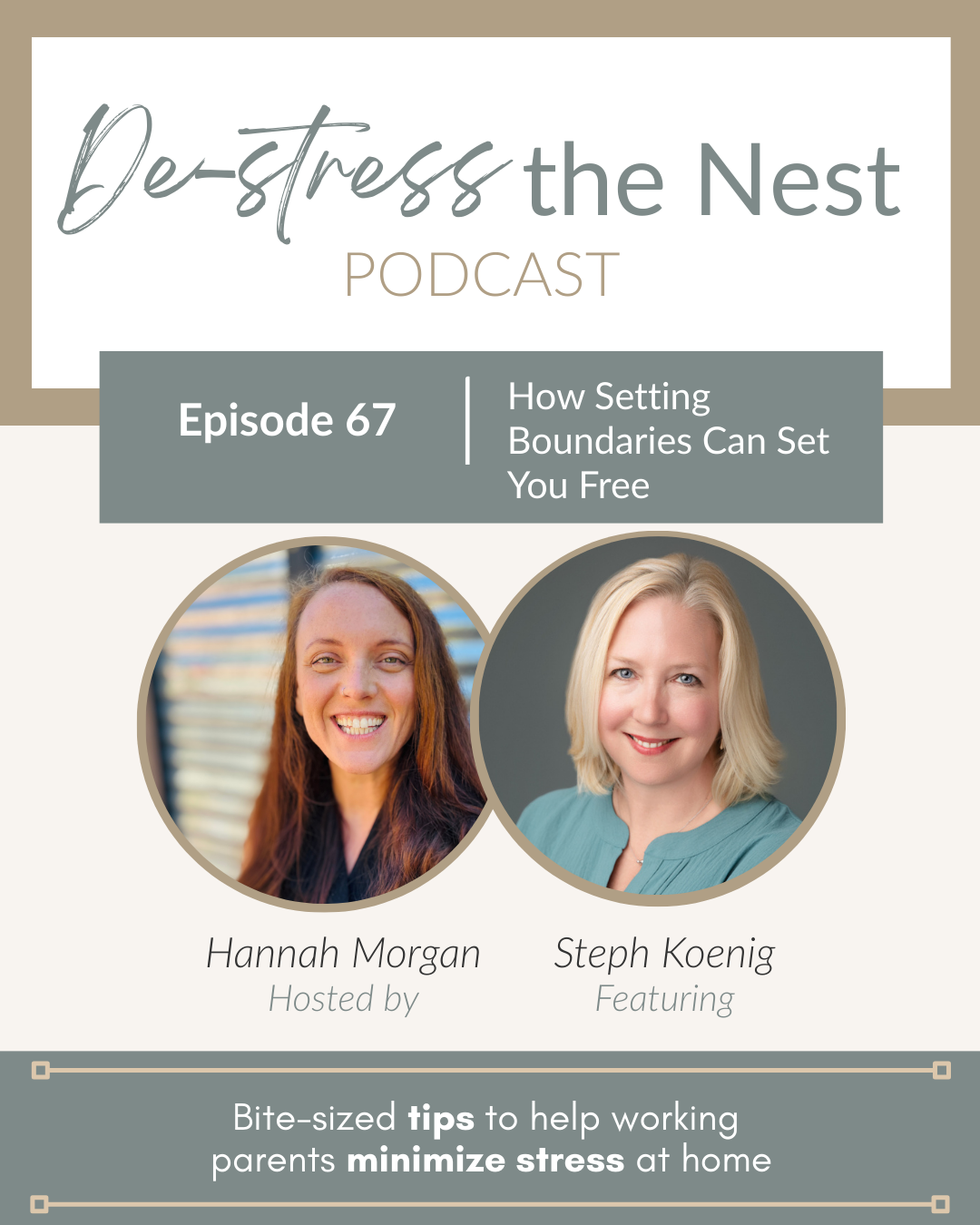
Boundaries are often talked about as limits—but what if they’re actually the key to more freedom? In this episode, Hannah Morgan is joined by working mom coach Steph Koenig to explore how thoughtful, flexible boundaries can help parents reclaim their time, identity, and peace of mind.
Steph explains why boundaries rooted in self-awareness—not rigidity—are essential for working parents. From navigating the blurred lines between work and home to protecting your sense of self beyond your roles as parent and professional, this conversation reframes boundaries as tools for connection rather than restriction.
Together, Hannah and Steph discuss how boundaries evolve with seasons of life, why listening to your body is critical when something isn’t working, and how prioritizing yourself first ultimately allows you to show up better for everyone else.
Key Takeaways
You can only control yourself: Boundaries begin with recognizing that you can’t manage others’ reactions—only your own thoughts, feelings, and actions.
Rigid doesn’t mean strong: Boundaries need flexibility to adapt to changing seasons of life without breaking down.
Awareness comes first: When a boundary isn’t working, your body and emotions often signal it before your mind does.
Boundaries protect identity: Healthy boundaries create space for you to exist beyond work and parenting roles.
Self-care strengthens connection: Putting yourself first allows you to be more present and engaged with others.
Quotes
“You can only control your own thoughts, feelings, and actions—and that realization is incredibly freeing.”
“Rigid boundaries don’t equal strong boundaries. Flexibility is what makes them sustainable.”
“If a boundary isn’t creating freedom, it’s time to reassess it.”
“Putting yourself first doesn’t make you less of a parent—it makes you a better one.”
“Boundaries aren’t about restriction; they’re about creating space for what matters most.”
Resources Mentioned
Steph Koenig — Time & Energy Coach
Website: www.stephkoenig.com
Instagram: @stephkoenigcoaching
Heron House Management: Virtual house management for busy families: we handle your to-dos so you can focus on what matters most.st.
Subscribe & Leave a Review:
If you enjoyed this episode, please subscribe and leave a review on Spotify, iHeartRadio, Apple Podcasts or your favorite podcast platform. Your feedback helps us reach more listeners and continue to bring you valuable content!
Episodes Released Weekly on Tuesdays
This episode of De-Stress the Nest is sponsored by Heron House Management.
About Heron House Management:
Heron House Management is a virtual house management service that takes the stress out of your busy life by taking on your mental load and managing your To Do list. We provide fractional virtual house management for busy families at 10, 15 and 20+ hours/month.
Meal planning, signing up for kids activities, scheduling doctor's appointments, finding a house cleaner, planning your kid's birthday party, getting quotes for that home renovation project, or scheduling a monthly date night with your significant other and so much more. We do it all!
-
[00:02] Hannah Morgan:
Welcome to De-Stress the Nest, a podcast for busy parents where experts share bite-sized tips on how to create systems that minimize stress at home. I’m your host, Hannah Morgan.[00:14] Hannah Morgan:
Today’s episode is sponsored by Heron House Management, the first-ever virtual house management service that lightens your mental load by handling your to-do list with monthly subscriptions of 10, 15, and 20+ hours per month. From meal planning and doctor’s appointments to birthday parties and home projects, Heron House Management helps busy families reclaim their time and live their best lives. Learn more at heronhousemanagement.com.[00:46] Hannah Morgan:
Happy New Year, everybody. Welcome back to this week’s episode of De-Stress the Nest—the first episode of 2026. I’m thrilled to be sharing a conversation with Steph Koenig, an incredible working mom coach, who joins us to talk about boundaries—why they’re so important as working parents, and how to preserve balance when work and home life don’t have a clean divide.[01:22] Hannah Morgan:
Steph, I’m so excited to have you here. Let’s start by talking about boundaries. This is such an important topic, especially for working parents.[01:34] Steph Koenig:
Thank you so much for having me, Hannah. I love talking about boundaries because they really are foundational. One of the biggest shifts for me personally was realizing that you can only control your own thoughts, feelings, and actions. You can’t control anyone else’s—and once you really understand that, it’s incredibly freeing.[02:05] Steph Koenig:
I might not be able to control my kids’ behavior or how my partner reacts, but I can control how I respond. And that’s where boundaries actually live.[02:27] Hannah Morgan:
That’s such an important reframe. I think so many of us feel like boundaries are about controlling outcomes, when really they’re about protecting ourselves.[02:43] Steph Koenig:
Exactly. And another big misconception is that rigid boundaries are stronger boundaries. They’re not. Boundaries need flexibility to work long-term, especially as your seasons of life change.[03:05] Steph Koenig:
If a boundary doesn’t flex, it eventually breaks. And when it breaks, people feel like they’ve failed, when really the boundary just wasn’t designed to support their reality.[03:29] Hannah Morgan:
Can you give an example of that? What does a boundary that isn’t working actually look like?[03:39] Steph Koenig:
A lot of times, your body tells you before your mind does. You might feel tense, irritated, disconnected, or resentful. Those are signs that something isn’t working.[03:58] Steph Koenig:
For example, I once had a hard rule that I would stop working at 5:00 p.m. every day, no matter what. But I noticed that even though I was physically with my family, mentally I was still stuck in work mode. That boundary wasn’t actually giving me freedom.[04:28] Steph Koenig:
So I adjusted it. Maybe I needed a buffer between work and home, like a walk or a short reset. Boundaries should support your life, not make it harder.[04:51] Hannah Morgan:
That distinction is huge—boundaries as support instead of restriction.[05:00] Steph Koenig:
Yes. We often think multitasking is the answer, but it’s really just task-switching. And that constant switching makes it harder to be present anywhere.[05:20] Hannah Morgan:
I hear from so many parents who feel like their identity has shrunk down to just work and parenting. How do boundaries help protect that sense of self?[05:39] Steph Koenig:
This is where mindset is everything. Setting boundaries doesn’t make you selfish—it actually makes you more sustainable. You have to put your oxygen mask on first.[05:59] Steph Koenig:
When you prioritize yourself, you show up more fully for your kids, your partner, and your work. You’re not running on empty all the time.[06:17] Hannah Morgan:
That can be really hard for parents to internalize, especially moms.[06:27] Steph Koenig:
Absolutely. We’ve been conditioned to believe that putting ourselves last is what makes us good parents. But in reality, it just leads to burnout.[06:45] Steph Koenig:
Boundaries are how you protect your energy, your identity, and your values. They’re not walls—they’re guidelines.[07:03] Hannah Morgan:
I love that. So as people are listening to this at the beginning of a new year, what’s one place they can start?[07:15] Steph Koenig:
Start by noticing where you feel resentment or exhaustion. That’s usually where a boundary is missing or needs adjusting. You don’t have to overhaul your whole life—just start with one area.[07:38] Steph Koenig:
And remember, boundaries evolve. What worked last year might not work now, and that’s okay.[07:55] Hannah Morgan:
That permission to adjust feels really powerful.[08:03] Steph Koenig:
It is. Freedom comes from allowing yourself to change, not from forcing yourself into rigid rules.[08:18] Hannah Morgan:
Steph, this has been such a grounding conversation. Thank you so much for sharing your wisdom.[08:30] Steph Koenig:
Thank you, Hannah. I really appreciate being here.[09:45] Hannah Morgan:
Thanks for listening to De-Stress the Nest, the podcast where experts share bite-sized tips on how to minimize stress at home. Don’t forget to subscribe and tune in every Tuesday for more ways to make home feel easier.