
Episode 86 – The Reality of Returning from Living Abroad with David Schnurman
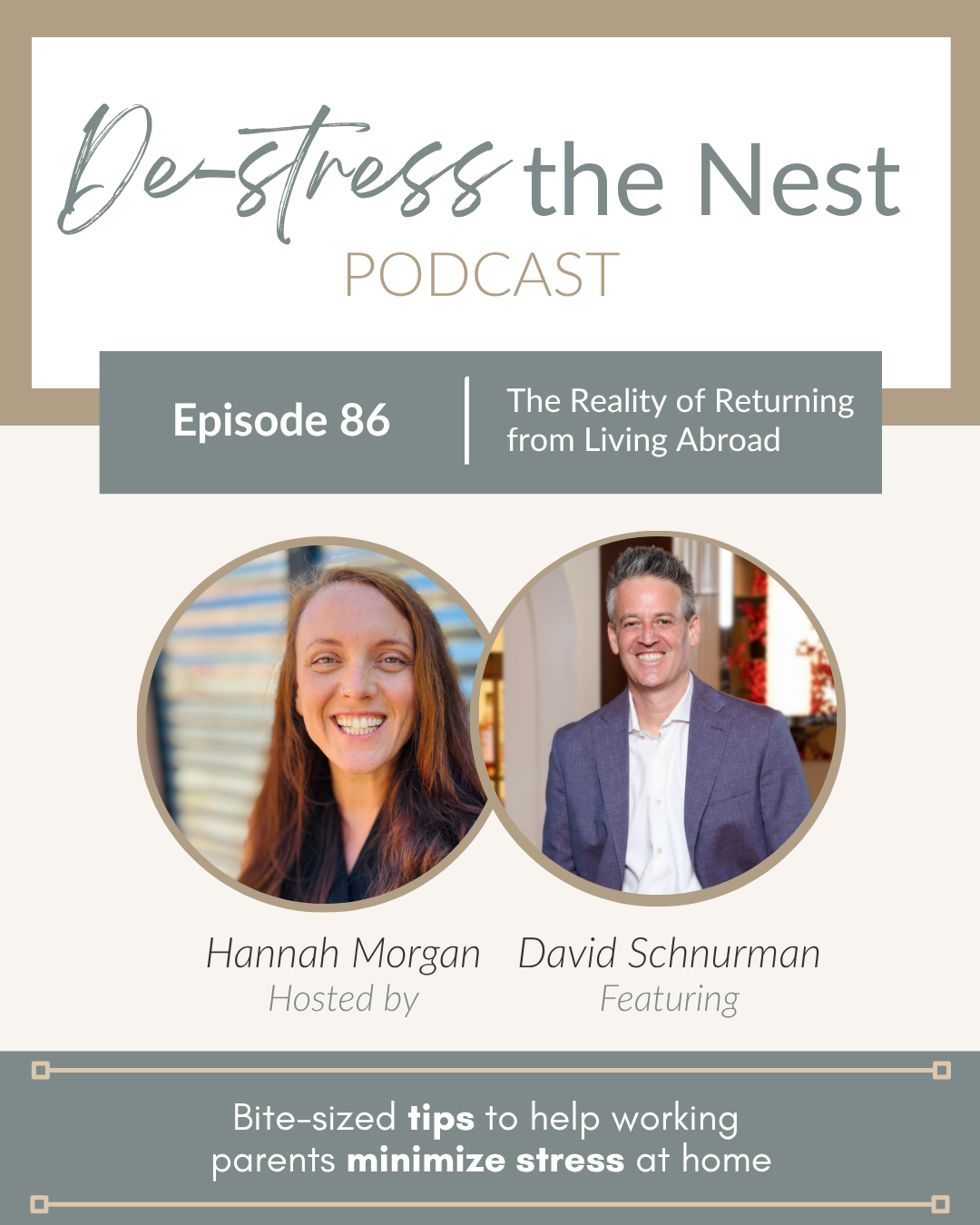
What happens after the adventure ends?
In this episode of De-Stress the Nest, Hannah Morgan welcomes back David Schnurman, author of Eleven Suitcases, to discuss a side of living abroad that isn't talked about nearly enough: returning home.
After moving his family from Brooklyn to Barcelona during the pandemic, what began as a one-year experiment turned into a multi-year international adventure. But eventually, the family returned to the United States—and the transition back wasn't what they expected.
David shares the emotional reality of reverse culture shock, the challenges of readjusting to life in the U.S., the surprising disconnect between expectations and reality, and why some families choose to move abroad again after returning home.
Whether you've dreamed of moving abroad, have lived internationally yourself, or simply wonder how travel changes the way we see home, this conversation offers a fascinating perspective on family, identity, and the lasting impact of stepping outside your comfort zone.
Key Takeaways
Returning home can be just as challenging as moving abroad.
Reverse culture shock is a very real experience.
Expectations of "going back to normal" often don't match reality.
Living abroad changes the way you see your home country.
Children experience international moves differently than adults.
Meaningful travel experiences often become part of a family's identity.
Adventure doesn't always require permanent relocation—it can take many forms.
The "W Curve" explains the emotional highs and lows of adapting to a new culture and returning home.
Quotes
"Within a month, you start thinking to yourself, was that a dream?"
"It's a bug that once you get, you sort of don't lose."
"Nothing's ever as good as the first time."
"There were families who moved back to the States and within a year or two moved back to Spain."
"One of the things we learned while we were away is called the W Curve."
"We're going to continue to do more adventures."
Resources Mentioned
11 Suitcases - David Schnurman’s book about moving to Barcelona with kids
Heron House Management - Virtual house management for busy families: we handle your to-dos so you can focus on what matters most.
If you enjoyed this episode, please subscribe and leave a review on Spotify, iHeartRadio, Apple Podcasts or your favorite podcast platform. Your feedback helps us reach more listeners and continue to bring you valuable content!
Episodes Released Weekly on Tuesdays
This episode of De-Stress the Nest is sponsored by Heron House Management. Learn more at www.heronhousemanagement.com.
About Heron House Management:
Heron House Management is a virtual house management service that takes the stress out of your busy life by taking on your mental load and managing your To Do list. We provide fractional virtual house management for busy families at 10, 15 and 20+ hours/month.
Meal planning, signing up for kids activities, scheduling doctor's appointments, finding a house cleaner, planning your kid's birthday party, getting quotes for that home renovation project, or scheduling a monthly date night with your significant other and so much more. We do it all! Learn more at www.heronhousemanagement.com.
About Hawkeye Focus Coaching:
Hawkeye Focus Coaching helps ADHD executives, entrepreneurs, and busy professionals turn ideas into action. Through personalized, hands-on coaching, deep work sessions, accountability, and practical systems, we help clients overcome overwhelm, stay focused on what matters most, and make consistent progress toward their goals.
Whether you're launching a business, leading a team, managing a major project, or trying to get out of constant firefighting mode, Hawkeye Focus Coaching helps you work with greater clarity, confidence, and momentum. Learn more at www.hawkeyefocuscoaching.com.
-
[00:02] Hannah Morgan:
Welcome to De-Stress the Nest, a podcast for busy parents where experts share bite-sized tips on how to create systems that minimize stress at home. I’m your host, Hannah Morgan.[00:14] Hannah Morgan:
Today’s episode is sponsored by Heron House Management, the first-ever virtual house management service that lightens your mental load by handling your to-do list with monthly subscriptions of 10, 15, and 20+ hours per month. From meal planning and doctor’s appointments to birthday parties and home projects, Heron House Management helps busy families reclaim their time and live their best lives. Learn more at heronhousemanagement.com.[00:46] Hannah Morgan:
Welcome back to De-Stress the Nest. Today I’m joined by David Schnurman, author of Eleven Suitcases. David previously joined us to talk about moving his family abroad, and today we're discussing what happened when that chapter came to an end and it was time to come home.[01:15] Hannah Morgan:
David, welcome back. For anyone who may not have heard your first episode, can you remind us a little bit about your family's journey?[01:30] David Schnurman:
Absolutely. My family moved from Brooklyn to Barcelona during the pandemic. What started as a one-year experiment turned into several years living abroad. Eventually we returned to the United States, and while we anticipated some adjustment, we quickly realized that coming home carried its own challenges.[02:12] Hannah Morgan:
I think that's something people don't talk about enough. We hear about the excitement of moving abroad, but we rarely hear about the experience of acclimating back.[02:32] David Schnurman:
Exactly. There's actually a concept called reverse culture shock. You expect home to feel familiar, but you've changed, your family has changed, and your perspective has changed. Returning can feel surprisingly disorienting.[03:05] David Schnurman:
Within a month, you start thinking to yourself, "Was that a dream?" Life abroad can start to feel almost unreal once you're back in your old routines.[03:38] Hannah Morgan:
That's fascinating because it was always your plan to come back, but acclimating back is something we don't really prepare for.[04:02] David Schnurman:
One of the things we learned while we were away is called the W Curve. It describes the emotional journey people experience when adapting to a new culture and then adapting back to their original culture.[04:35] David Schnurman:
The initial excitement gives way to challenges, then eventually adjustment. When you come home, the process often repeats itself. Many families don't expect that second adjustment period.[05:08] Hannah Morgan:
And you get to have that side-by-side comparison. It's very interesting because you've experienced life in both places and can see strengths and weaknesses more clearly.[05:35] David Schnurman:
Absolutely. Living abroad changes the way you view your home country. You notice things you never noticed before, both positive and negative.[06:02] David Schnurman:
There were families we knew who moved back to the States and within a year or two moved back to Spain. Once you've experienced that lifestyle, it can be difficult to completely let it go.[06:35] Hannah Morgan:
I think a lot of people are very curious about the transformations that happen when you live abroad. Not just the travel itself, but how it changes your identity and your family.[07:02] David Schnurman:
I think that's right. It's a bug that once you get, you sort of don't lose. You begin seeing possibilities everywhere.[07:40] David Schnurman:
Nothing's ever as good as the first time, but that doesn't mean the adventure is over. It just means the next chapter looks different.[08:15] Hannah Morgan:
So what does the future look like for your family? Do you see yourselves staying put, or are more adventures ahead?[08:35] David Schnurman:
We're definitely going to continue to do more adventures. They may not look exactly like Barcelona, but we've learned how valuable those experiences are for our family.[09:05] Hannah Morgan:
I love that. It sounds like living abroad became less about a destination and more about a mindset.[09:25] David Schnurman:
Exactly. The biggest lesson was realizing that we can intentionally create experiences that challenge us, broaden our perspectives, and bring us closer together as a family.[10:00] Hannah Morgan:
Such a powerful takeaway. Thank you so much for sharing your experience and for coming back to talk about this side of the story.[10:18] David Schnurman:
Thank you for having me. It's been great.[11:25] Hannah Morgan:
Thanks for listening to De-Stress the Nest, the podcast where experts share bite-sized tips on how to minimize stress at home. Don’t forget to subscribe and tune in every Tuesday for more ways to simplify your life.
