Episode 85 – The Need for Affordable Childcare and Paid Family Leave with Paige Connell
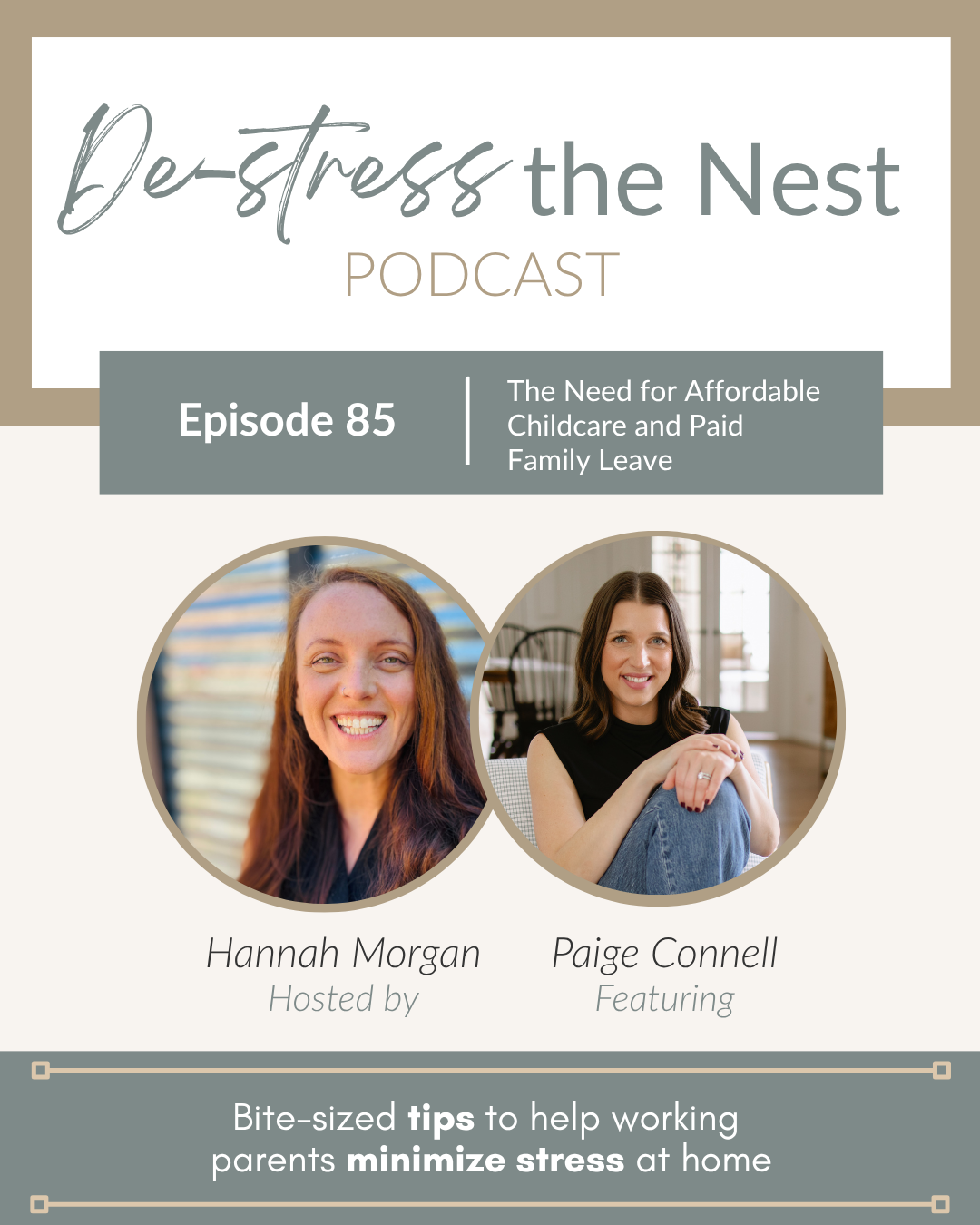
Affordable childcare and paid family leave have become some of the biggest stressors facing modern working families — and yet many parents still feel like they’re expected to “figure it out” on their own.
In this episode of De-Stress the Nest, Hannah Morgan sits down with Paige Connell, content creator and advocate in the motherhood and mental load space, to talk about the realities of childcare costs, parental leave, and how these systems disproportionately impact women and working parents.
Paige shares why childcare is not simply an individual family issue, but a broader economic and societal issue that affects businesses, workforce participation, and family wellbeing. Together, Hannah and Paige discuss the cultural expectations around parenting, the need for equitable paid leave policies, and why workplace support matters more than ever.
Key Takeaways
Childcare is essential: Most working families rely on childcare in order to stay employed and financially stable.
Costs are rising quickly: Affordable childcare is becoming harder to access for many families.
Women are disproportionately impacted: Mothers are more likely to reduce hours, change roles, or leave the workforce because of childcare gaps.
Paid leave affects long-term equity: Lack of paid leave impacts earnings, retirement savings, and career growth.
Leave should support all parents: Inclusive policies normalize involved parenting from day one.
Workplaces play a role: Companies can help shift culture by offering and actively encouraging paid leave and childcare support.
Quotes
“Childcare is often viewed as a ‘you problem,’ but it actually benefits the economy and society at large.”
“The lack of affordable childcare disproportionately impacts women.”
“People across the board believe there should be affordable, safe childcare.”
“Every parent deserves this time.”
“We need men to take leave, and we need companies not just to offer it, but to encourage it.”
Resources Mentioned
Paige Connell (@sheisapaigeturner) - Content creator and motherhood thought leader sharing honest conversations about gender equity, mental load, and the realities of modern parenthood.
Heron House Management - Virtual house management for busy families: we handle your to-dos so you can focus on what matters most.
If you enjoyed this episode, please subscribe and leave a review on Spotify, iHeartRadio, Apple Podcasts or your favorite podcast platform. Your feedback helps us reach more listeners and continue to bring you valuable content!
Episodes Released Weekly on Tuesdays
This episode of De-Stress the Nest is sponsored by Heron House Management. Learn more at www.heronhousemanagement.com.
About Heron House Management:
Heron House Management is a virtual house management service that takes the stress out of your busy life by taking on your mental load and managing your To Do list. We provide fractional virtual house management for busy families at 10, 15 and 20+ hours/month.
Meal planning, signing up for kids activities, scheduling doctor's appointments, finding a house cleaner, planning your kid's birthday party, getting quotes for that home renovation project, or scheduling a monthly date night with your significant other and so much more. We do it all!
-
[00:00:02] Hannah Morgan:
Welcome to De-Stress the Nest, a podcast for busy parents where experts share bite-sized tips on how to create systems that minimize stress at home. I’m your host, Hannah Morgan.[00:00:14] Hannah Morgan:
Today’s episode is sponsored by Heron House Management, the first-ever virtual house management service that lightens your mental load by handling your to-do list with monthly subscriptions of 10, 15, and 20+ hours a month. From meal planning and doctor’s appointments to birthday parties and home projects, Heron House Management helps busy families reclaim their time and live their best lives. Learn more at heronhousemanagement.com.[00:00:44] Hannah Morgan:
Paige Connell, I’m so excited to welcome you to the show today. Let’s start off by hearing a little bit more about who you are, the work you do, and the message that you have for other working moms.[00:01:02] Paige Connell:
Sure. I am a working mom of four kids, and I am a content creator and a leading thought leader in the motherhood space, specifically focusing on the mental load of motherhood, gender equity, and the affordability crisis as it pertains to childcare, and how all of those things are connected.[00:01:27] Paige Connell:
So I spend most of my time talking about these larger systemic issues that impact the day-to-day lives of others.[00:01:37] Hannah Morgan:
Excellent. So glad you’re joining us, and shout out to all of the content that you’re putting out there on social media. We’ll link it in the show notes, but be sure to give Paige a follow. There’s tons to learn from the content she’s sharing and the message she’s bringing to working parents everywhere.[00:01:58] Paige Connell:
Thank you.[00:02:01] Hannah Morgan:
So, Paige, as we talk about all of the dynamics that working parents are navigating in modern-day parenting, a big piece of it is often childcare, or lack thereof. It’s a source of stress, it’s a source of financial strain.[00:02:19] Hannah Morgan:
This is a topic that you’ve spent a lot of time sharing about on your platforms, and I want to give you an opportunity to talk a little bit more about the urgent need for childcare and paid leave, and what that means in 2025.[00:02:39] Paige Connell:
Sure. I think this is a problem that is plaguing pretty much every average American family. Most homes these days are dual-income homes or single-parent households, and there is a desperate need for safe and affordable childcare, and yet there is a lack of it available.[00:03:03] Paige Connell:
The childcare that is available is incredibly unaffordable. We’re in this moment in time where childcare, which most people don’t recognize, is the fastest rising cost in our country.[00:03:21] Paige Connell:
It’s rising faster than groceries and housing prices. It’s rising at, I think, two times the rate of inflation. It is incredibly expensive, and for most families, it is a necessity. It is not a luxury.[00:03:42] Paige Connell:
Unfortunately, the lack of affordable childcare disproportionately impacts women. Women are twice as likely to adjust their careers or leave the workforce to accommodate for gaps in childcare.[00:04:00] Paige Connell:
It’s not something that is getting the support or funding or subsidies that it deserves in our country. Parents are getting very loud about the lack of affordable childcare and what that means for their families.[00:04:19] Paige Connell:
There’s more awareness than ever, which is incredibly important, but now we need supports in place for families.[00:04:31] Paige Connell:
Childcare is often viewed as a “you problem,” right? Like, you chose to have kids, you figure it out. But childcare actually benefits the economy and society at large.[00:04:47] Paige Connell:
It has a good ROI for businesses that invest in it. Childcare is not just something that benefits individual parents. It is also a huge barrier. It’s a reason why some people are not having children, or are having fewer.[00:05:06] Hannah Morgan:
Yeah, and people don’t realize how expensive it is. We’re talking about one to two thousand dollars a month per kid, depending on where you live.[00:05:20] Hannah Morgan:
I’m always shocked when people have childcare options that cost less than a thousand dollars a month per child. Usually it’s some sort of part-time solution, or it’s a grandparent helping out.[00:05:38] Hannah Morgan:
Something that makes me so frustrated, especially seeing the news recently, is that people who are making large-scale decisions that impact access to affordable, high-quality childcare do not have the lived experience of being the person responsible for the children.[00:06:00] Hannah Morgan:
When I talk to my parents’ generation, they’re absolutely shocked because they have no idea what kind of financial burden this puts on families today.[00:06:13] Hannah Morgan:
Our generation is seeing the importance of women continuing to work, grow their careers, and invest in themselves. It’s a completely different lived experience for those of us navigating this now.[00:06:32] Paige Connell:
Yeah, and I think it’s also reflective of generational changes. Historically, people might have said, “Leave the kids with Grandma.” Well, Grandma’s still working, typically.[00:06:48] Paige Connell:
Or we’re having children older, so Grandma’s older and may not be able to care for two toddlers running around.[00:07:00] Paige Connell:
The world is vastly different, and we probably should have never relied on Grandma to begin with. She should have been allowed to retire.[00:07:12] Paige Connell:
If you look at constituents in this country, affordable childcare is pretty much a bipartisan issue. People across the board believe there should be affordable, safe childcare. That is not a divisive issue.[00:07:31] Paige Connell:
Now it’s really about finding solutions. What does that look like? Federally, we might struggle, but statewide, citywide, and even within organizations, we are seeing progress.[00:07:48] Paige Connell:
We recently saw a company launch a childcare effort where they’re giving people a stipend, which is huge. These things are amazing, and that’s progress.[00:08:01] Hannah Morgan:
Absolutely. And before we even get to the childcare conversation, we’re talking about paid leave, right? What do you do when you have a new baby at home, and what are companies offering?[00:08:18] Paige Connell:
Not every company offers paid leave, and not every state offers paid leave, so we have a lot of work to do. It should be federally mandated that we have access to paid parental leave and paid leave in general, but we don’t.[00:08:39] Paige Connell:
It is incredibly valuable for both parents to have paid parental leave. It’s important for women when it comes to equity in the workplace and at home to have paid parental leave for both them and their partner.[00:08:57] Paige Connell:
When we don’t have paid parental leave, women lose out on lifetime earnings, retirement savings, and benefits. Women tend to retire later because of things like unpaid parental leave.[00:09:15] Paige Connell:
We also return to work sooner, and infant childcare is the most expensive form of childcare. So financially, mentally, physically, and emotionally, paid leave has a massive impact on families.[00:09:35] Hannah Morgan:
Yeah, and I think it’s so important that people realize this is an issue that affects all genders and is also important for adoptive parents.[00:09:48] Hannah Morgan:
Inclusive parental leave policies make such a dramatic difference in normalizing who is an involved parent.[00:10:03] Hannah Morgan:
I had a conversation recently with a friend whose company has a generous paid leave policy, but she got frustrated seeing male colleagues use parental leave to write a book or work on a passion project.[00:10:22] Hannah Morgan:
That narrative of “I have so much free time with this paid vacation” is exactly the opposite of what we need. That time needs to be around contributing as an equal partner.[00:10:42] Hannah Morgan:
In some countries, they’ve actually mandated that men take parental leave because they found that culture wasn’t shifting the way the policy intended when paid leave was accessible to everyone.[00:10:58] Paige Connell:
Exactly. We need men to take this. We need men to take it for the right reasons, which is taking care of their family.[00:11:09] Paige Connell:
Every parent deserves this time, whether they are birth parents, foster parents, or adoptive parents. It is incredibly valuable.[00:11:22] Paige Connell:
We need it to be available first and foremost, and then we need people to take it. Companies should not just offer it, but encourage it and protect that time.[00:11:38] Hannah Morgan:
Absolutely. I remember watching Working Moms, the Canadian show, and one of the moms said after a full year of paid leave, “I don’t know if I’m ready to go back to work yet.”[00:11:54] Hannah Morgan:
And I thought, some of us are going back while we are literally still bleeding. It’s such a different narrative around what’s acceptable and what’s offered.[00:12:04] Hannah Morgan:
Thanks for listening to De-Stress the Nest, the podcast where experts share bite-sized tips on how to minimize stress at home. Don’t forget to subscribe and tune in every Tuesday for more ways to simplify your life.