Episode 77 – How a Digital Calendar Can Save Your Sanity with Amy Briggs
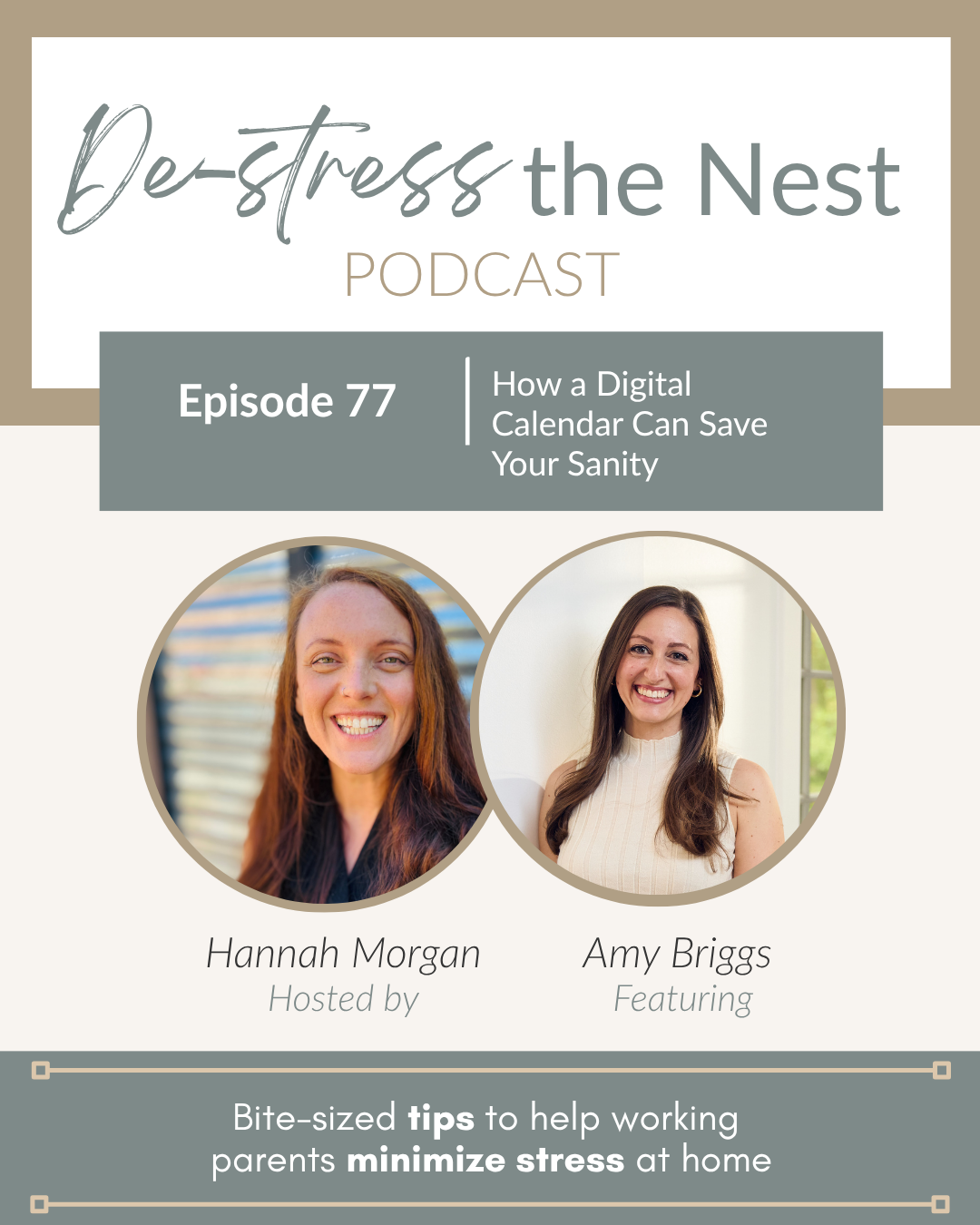
If you’re the one in your household keeping track of everything — school events, appointments, childcare logistics, and the endless mental checklist — this episode is for you.
In this episode of De-Stress the Nest, Hannah Morgan is joined by returning guest Amy Briggs, founder and CEO of Aviva, to talk about how digital calendars can go from a basic scheduling tool to a powerful system for reducing mental load.
Amy shares how most families already have some form of calendaring in place, but the real transformation happens when you take it a step further — using calendar-based reminders that are shared, visible, and actionable for everyone involved.
By moving reminders out of your head (or your notes app) and into a shared system, you can reduce communication breakdowns, eliminate last-minute scrambles, and stop being the default “keeper of all the information.”
If you’re tired of being the family operations manager, this episode will show you how to build a system that actually shares the load.
Key Takeaways
Calendars are more than schedules: A shared digital calendar can become a central system for managing family logistics, not just tracking events.
Reminders need a shared home: Moving reminders out of your head (or scattered apps) and into your calendar ensures everyone has access to the same information.
Stop being the gatekeeper: When information lives in one shared place, you’re no longer responsible for remembering, relaying, and managing every detail.
Visibility creates shared ownership: When everyone can see what’s happening, it becomes easier for partners and caregivers to participate and take initiative.
Anticipation reduces stress: Calendar reminders help families move from reactive scrambling to proactive planning.
Systems reduce tension: A clear, shared system prevents last-minute chaos and lowers overall household stress.
Quotes
“Reminders need a landing place where everyone can see them.”
“You don’t have to be the gatekeeper of all the information.”
“We’ve all fallen into this role of managing everything — but we don’t have to stay there.”
“The goal is to move from reactive mode to anticipatory mode.”
“No one gets joy from being the operations manager of the household.”
“When information is visible, it becomes shared.”
Resources Mentioned
Aviva– Amy Briggs’ family calendar app that helps parents automatically turn emails into calendar events and streamline scheduling.
Heron House Management– Virtual house management for busy families: we handle your to-dos so you can focus on what matters most.
If you enjoyed this episode, please subscribe and leave a review on Spotify, iHeartRadio, Apple Podcasts or your favorite podcast platform. Your feedback helps us reach more listeners and continue to bring you valuable content!
Episodes Released Weekly on Tuesdays
This episode of De-Stress the Nest is sponsored by Heron House Management.
About Heron House Management:
Heron House Management is a virtual house management service that takes the stress out of your busy life by taking on your mental load and managing your To Do list. We provide fractional virtual house management for busy families at 10, 15 and 20+ hours/month.
Meal planning, signing up for kids activities, scheduling doctor's appointments, finding a house cleaner, planning your kid's birthday party, getting quotes for that home renovation project, or scheduling a monthly date night with your significant other and so much more. We do it all!
-
00:00
Hannah Morgan: Welcome to De-Stress the Nest, a podcast for busy parents where experts share bite-sized tips on how to create systems that minimize stress at home. I'm your host, Hannah Morgan. Today’s episode is sponsored by Heron House Management — the first-ever virtual house management service that lightens your mental load by handling your to-do list with monthly subscriptions of 10, 15, and 20+ hours per month. From meal planning and doctor’s appointments to birthday parties and home projects, Heron House Management helps busy families reclaim their time and live their best lives. Learn more at heronhousemanagement.com.00:38
Hannah Morgan: Welcome back to this week's episode of De-Stress the Nest. I’m thrilled to bring back Amy Briggs to talk about the importance of using a digital calendar.00:56
Hannah Morgan: If you're anything like me and you've got kids running in every direction, your calendar becomes the central hub for your entire family.01:12
Hannah Morgan: Amy has taken calendaring to the next level with her tool, Aviva, and today we’re talking about how outsourcing and sharing your calendar can reduce mental load and help you function as a team.01:32
Hannah Morgan: Amy, I’m so happy to have you back. Let’s start with who you are and what you do.01:42
Amy Briggs: Thank you so much for having me. I’m Amy Briggs, a mom of two daughters and a speech-language pathologist by training.01:58
Amy Briggs: I’m also the founder and CEO of Aviva, an app that helps busy parents automatically turn emails into calendar events and manage family logistics more efficiently.02:18
Hannah Morgan: Today we’re talking about schedule reminders and how they can unlock the next level of partnership and mental load relief.02:34
Amy Briggs: Most parents already have some kind of system, often digital, for tracking schedules, school activities, and obligations.02:50
Amy Briggs: That’s a great first step, but the next level is using calendar-based reminders.03:04
Amy Briggs: Many people rely on notes apps, reminders apps, or even notebooks, but those tools require an extra step to move that information where it needs to go.03:22
Amy Briggs: And most importantly, those systems don’t automatically distribute information to everyone who needs it.03:38
Amy Briggs: When reminders live in a shared calendar, they have a landing place where everyone can see them.03:54
Amy Briggs: That reduces communication breakdown and removes the burden from one person having to relay everything.04:10
Hannah Morgan: It really removes you as the gatekeeper of all the information.04:24
Hannah Morgan: Instead of being the person responsible for remembering everything, it’s all in one place for everyone to access.04:40
Amy Briggs: Exactly. No one enjoys being the operations manager of the household.04:56
Amy Briggs: Many of us fall into that role by default, but we don’t have to stay there.05:12
Amy Briggs: When information is visible, it creates shared understanding and shared responsibility.05:28
Amy Briggs: It also helps others learn what needs to be done and how to anticipate needs moving forward.05:44
Amy Briggs: That’s the real shift — moving from reactive mode to anticipatory mode.06:00
Amy Briggs: Instead of scrambling at the last minute, everyone knows what’s coming and can prepare.06:16
Hannah Morgan: That prevents those high-stress moments where something is forgotten or rushed.06:30
Hannah Morgan: A good system removes that tension and keeps things running smoothly.06:44
Amy Briggs: Exactly. It takes the pressure off one person and distributes it across the whole household.07:00
Hannah Morgan: Thank you so much for sharing this — such actionable and helpful insight.07:10
Amy Briggs: My pleasure.07:16
Hannah Morgan: Thanks for listening to De-Stress the Nest, the podcast where experts share bite-sized tips on how to minimize stress at home. Don’t forget to subscribe and tune in every Tuesday for more ways to simplify your life.